
When Universities Don't Control Their Borders
Another case study in irony-deficiency of the "anti-colonialists" who try to occupy every college department they haven't already ruined

Just what the hell is a “border surveillance scholar”? The University of Texas at Austin looked up one day and discovered it had one, and then denied this “scholar” tenure and advancement, despite the recommendation of many faculty peers and outside “experts.”

Gosh, I wonder if there is any hint in the news story about this that might help explain it:
Border-surveillance scholar Iván Chaar López was denied tenure at the University of Texas at Austin after being recommended by more than 30 scholars, The Austin-American Statesman reported.
Records obtained by the Statesman showed that Chaar López exceeded the bar for tenure and that his American studies colleagues recommended him for promotion pending approval from UT President Jim Davis, a presidential committee and the system Board of Regents. In February, the tenure committee unexpectedly denied Chaar López’s tenure application without explanation. He told the Statesman that he fears it was because his research on the ways border-surveillance technologies are tied to history and race is controversial among conservative officials.

Well, to no one’s surprise, Prof. Chaar-Lopez uses the term that 95 percent of Hispanics forcefully reject—”Latinx.” From The Guardian:
Since the beginning of 2019, Donald Trump’s presidential campaign launched more than 2,000 ads on social media that warn people of the supposed threat of Latinx people. The aim of the ads was to mobilize support for a border wall and for border security by heightening fears of a migrant “invasion”. As a scholar who is working on a book about the history of border enforcement technologies such as drones, I know this is not the first time that Latinx people have been targeted by racist and xenophobic discourse that treats them as an invading force. Calls for border security today cannot be disentangled from the longer history of racist, white anxiety about black and brown bodies.
“Bodies” is another tell that the author is a left-wing loon. Like “Latinx,” it is a woke term that is only used on college campuses by the identity-mongers, usually in niche departments that end in “studies.”
Let’s look at the abstracts for a few of Prof. Chaar-Lopez’s published “scholarly” work. Let’s start with a book that might have been called “When the Terminator Meets Stephen Miller,” but instead it is this:
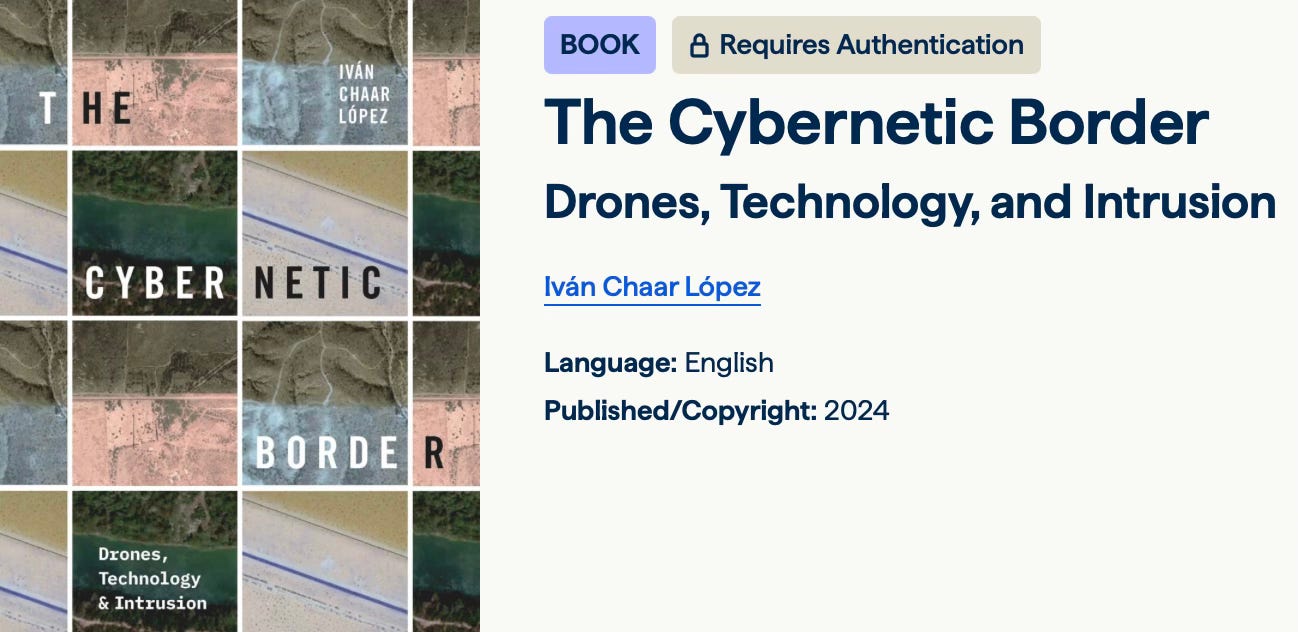
Description: In The Cybernetic Border, Iván Chaar López argues that the settler US nation requires the production and targeting of a racialized enemy that threatens the empire. The cybernetic border is organized through practices of data capture, storage, processing, circulation, and communication that police bodies and constitute the nation as a bounded, territorial space. Chaar López historicizes the US government’s use of border enforcement technologies on Mexicans, Arabs, and Muslims from the mid-twentieth century to the present, showing how data systems are presented as solutions to unauthorized border crossing. Contrary to enduring fantasies of the purported neutrality of drones, smart walls, artificial intelligence, and biometric technologies, the cybernetic border represents the consolidation of calculation and automation in the exercise of racialized violence.
Or there’s this one, from American Quarterly (which, if truth in labeling laws applied to academic journals, would be called Anti-American Quarterly):
Today’s US cybersecurity milieu can be traced, in part, to the encounter between electronic technology and border control during the 1970s. Federal officials argued at the time that, due to the end of the Bracero Program and passage of the Immigration and Nationality Act of 1965, “illegal aliens” constituted a “silent” and “invisible invasion” threatening the US nation. In the science of cybernetics, officials found the conceptual tools to organize border enforcement operations and institute order over border life. Intrusion detection systems installed on the southern border area in 1970 highlight how actors attempted to control racialized populations by managing information and communication processes. Cybernetics and intrusion detection systems, this article argues, aimed to draw an electronic “line in the sand.” They were put to work in making the nation’s boundaries both on the ground and on human bodies; in doing so, they reproduced US racial sorting logics while recoding them into bits of data. The “electronic fence,” as the system was known, was part and parcel of an infrastructure of technologies and knowledges targeting Mexicans. Tracing discourse networks in government publications and memoranda, technical reports, and newspapers, the essay charts the role of automation in US nation-making and in the management of racialized bodies.
Sorry for that, everybody, but you do need to take in the whole thing, not to believe it. Needless to say, the tacit premise of his work is that national borders themselves are illegitimate. But seldom will you find someone like Chaar Lopez willing to defend the proposition publicly.
Chaar-Lopez clearly thought it clever to mix left-racialism with technobabble—why not just call it “techoracism” and get it over with?—and managed to bamboozle UT/Austin’s American Studies department, though bamboozling academic departments with new jargon is a surprisingly easy route to tenure much of the time. It’s the self-licking ice cream cone of academia.
Kudos to the UT/Austin administration for finally exercising their dormant power to say “No!” to the relentless leftist politicization of their campus. Here’s a follow-on suggestion. Think of it as a long overdue border control for academic excellence against political activists masquerading as “scholars.” The UT/Austin administration ought to tell the 30 or so faculty who backed Chaar-Lopez for tenure that they would be best off seeking employment elsewhere.
Chaser—Can’t resist this story, while we’re on this beat:

Northeastern Illinois University’s enrollment in its gender studies degree program has remained below 10 students for five years running, the school’s data shows.
The university maintains a page tracking five-year enrollment trends every spring. The data reveals that gender studies is not a popular major at the school.
In spring 2021, only two students were enrolled in the Women’s, Gender and Sexuality Studies Bachelor of Arts. That number rose to six students in spring 2022 before declining to five students in 2023 and four students in both 2024 and 2025.
The university had an enrollment of 3,749 undergraduate students in spring 2025, which means that 0.11 percent of the student body was enrolled in the Women’s, Gender and Sexuality Studies degree.
So I checked: the NIU Women’s, Gender, and Sexuality Studies department has 21 faculty members listed in the department. Some are emeritus, and some are joint appointments with other departments, but regardless, this is absurd with only four students enrolling. If you look up the individual faculty, it’s just what you’d expect. Like the program adviser, who teaches “Social Construction of Whiteness, Feminist Pedagogy, Queer Theory and Practice, Anti Violence Work, Community Accountability and Transformative Justice.”
May I suggest here is a handy list of 21 professors whose positions can be eliminated?
The brightest people have the ability to explain difficult concepts to those outside their profession.
Dullards use profession specific lingo to mask their idiocy. The duplicitous hide their true intention behind a veil of obfuscation.
This UT woodtick could easily be replaced by a low performing AI.
They don't make scholars like they used to.