
Tuesday Digest
Another podcast, and some misc. highlights

• I’m finally back to my podcast series for Power Line on the new books coming out for the 250th anniversary of the Declaration of Independence coming fast upon us. This episode features my conversation with John G. West of the Discovery Institute, who sat down with me recently in his Seattle office to discuss his new book, Endowed by Our Creator: The Bible, Science, and the Battle for America’s Soul.


Arguments over the Declaration and the Founding sometimes take on the character of the famous Hindu story of the group of blind men touching an elephant, with the person touching a leg declaring the object to be a tree; the person touching the trunk declares the animal to be a snake; a third man touching the body thinks it is a wall, while a fourth touches the tail and thinks the object is a rope. Soon the group falls into argument, and begin even to distrust each other.
Such are the arguments sometimes about the Declaration and the Founding.
Margaret Thatcher once remarked that “Europe was created by history. America was created by philosophy.” What she had in mind here was the strain of thought that considered America and its founding thought as predominantly a product of enlightenment-era rational philosophy, especially as it crystalized in the work of John Locke. Hence the view of America as a “creedal” nation, founded on reason.
This general account has long attracted criticism for neglecting the contributions of Christianity, and our historical inheritance from England, albeit modified in substantial ways by our colonial and revolutionary experience.
These two camps that seem especially irreconcilable for some reason, though it ought to be possible in my mind to achieve a synthesis. Somehow it is seldom attempted, let alone successfully accomplished, so we go on firing from our intellectual fixed fortifications.
As the title suggests, West devotes considerable time to recounting in vivid and specific detail how Christian faith influenced the Declaration and the Founding, as suggested in the all-important phrase “Endowed by Our Creator.” But he adds some interesting and original perspectives on the attacks on the Declaration and its theological-political teaching by drawing out attention to the mid-19th century. As most listeners of this podcast or its cousins know, the Progressives, especially Woodrow Wilson, directly rejected the Declaration and its philosophy of natural rights because Wilson thought Hegel had displaced Locke, but West draws out in detail the other figure that influenced Wilson and the Progressives in their rejection of the founding. Remember that Wilson not only said to ignore the Declaration, but that our Constitution must be understood in Darwinian terms.
Thus perhaps the most significant contribution of West’s book is his account of how Darwinism, and a number of other evolutionary theorists (some of whom actually preceded Darwin) affected American political thought and prepared the way for the predations of the Progressives.
As usual, listen or download here:
• I neglected to flag for readers late last week my mischievous analysis of President Trump’s Rose Garden speech welcoming King Charles to America, entitled “The Sun Sets on Great Britain.” It’s a relatively short piece, but here is the climax in the second half:
A conspicuous lack of courage, “glory, destiny, and pride” marks Great Britain’s current retreat from its historic confidence and greatness, as Trump has candidly declared in other settings recently. While he referenced Churchill in this speech, surely some listeners had to recall his recent remarks that when it comes to Kier Starmer, “We aren’t dealing with Churchill anymore.”
His reference to Churchill and his close cooperation with FDR in World War II contained a subtle point that verges on the esoteric. After a typically Trumpian recollection of his mother, who came from “the very serious Scotland…where they had their greatest of warriors,” he circled back to King Charles, noting he had been the longest-serving Prince of Wales in British history. What few listeners likely remembered was that Churchill and FDR launched their World War II grand strategy on the decks of a British battleship, Prince of Wales.
Here, perhaps, only World War II history geeks will recall that the Prince of Waleswas ignominiously sunk off Singapore in the earliest weeks of the Pacific theater, rolling over to port (that is, its left side) before slipping beneath the waves. Today, Britain is listing heavily to port and is in danger of drowning on account of its lack of courage.
For all of Trump’s polite generosity to King Charles in his remarks, the absence of any current examples of Anglo-American shared greatness and cooperation is telling. Trump added that “the bust of your great prime minister [Churchill] rests proudly again in the Oval Office. Very proud to bring it back. We brought it back.” (Trump missed the chance to remind the King and listeners that Churchill was half-American; the temptation for a zinger had to be strong.) Was Trump deliberately poking the British for their current ambivalence, if not hostility, to Churchill’s courageous example? The subtext that the legacy of British greatness and courage is now to be found in America is undeniable to any attentive listener.
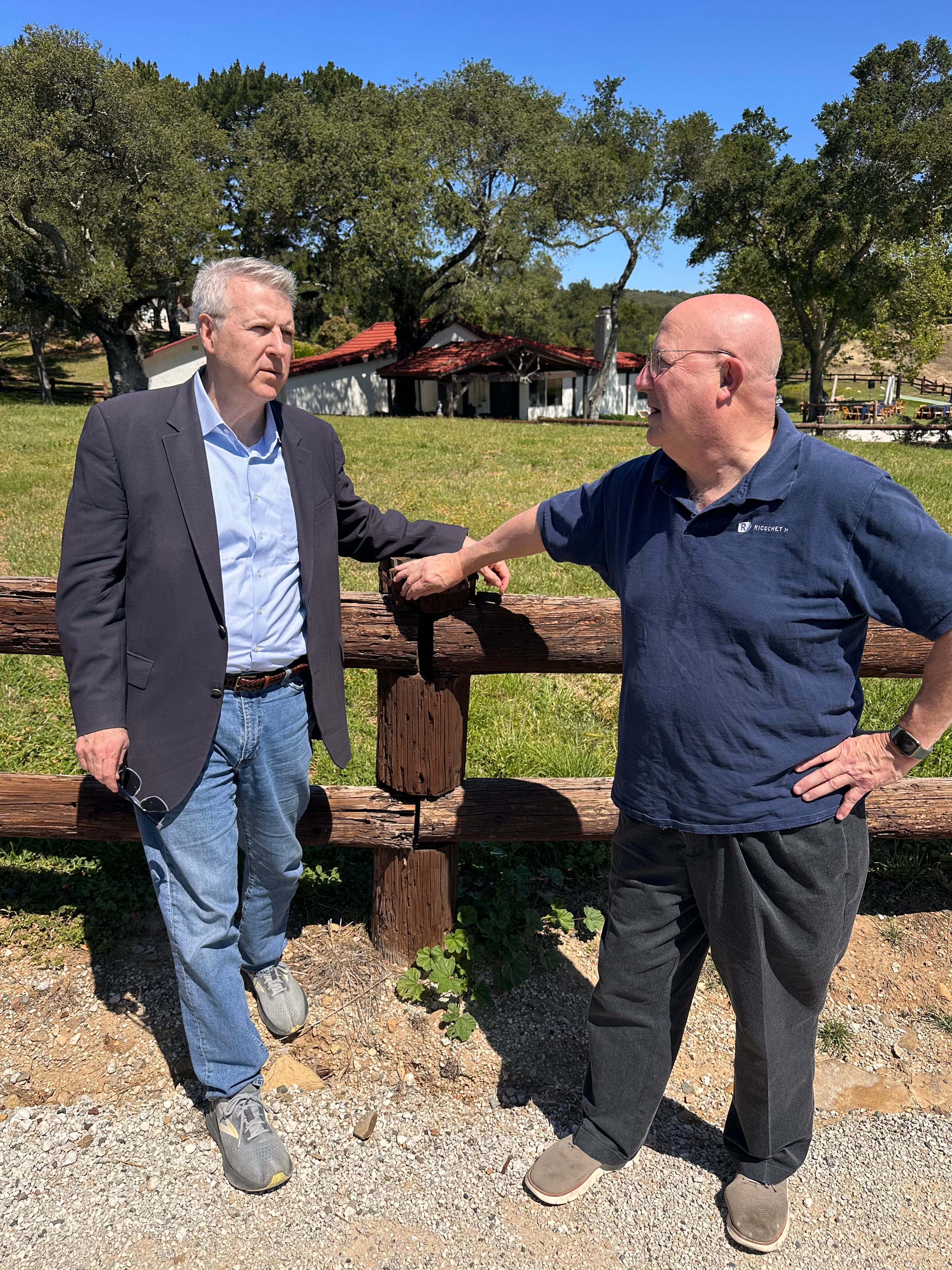
• One reason I was negligent in keeping up with things (like relating the one time I met Ted Turner 20 years ago—perhaps tomorrow, as it was very funny) was that I was totally absorbed in a two-day conference at the Reagan Library that culminated in a visit to Reagan’s mountain-top ranch north of Santa Barbara. I’ve visited it several time before, but it was a treat to do it this time in the company of Peter Robinson, the speechwriter who worked with Reagan on his justly famous Berlin Wall speech. And here we are:
I so appreciate the breadth and depth of topics covered in this Substack.
Dr. Hayward’s sprinkling of humor is icing on the cake.
The story of the sinking of the Prince of Wales is hilarious and apt as he notes Trump’s lack of current depictions of British-American cooperation.
Political liberalism and the Rights of Man arose from Judeo-Christian culture, and no other. Even deists like Hume, Smith, and Jefferson knew there was an "Author of Nature," and that our rights come from God and not Man.