
Is California Doomed?
The magic 8-ball returns the answer: "All signs say 'Yes.'"

Is California doomed?
Many of you will likely be saying, “YES! Let’s go home.” And I’m afraid that is the right answer. But for those of you who want the latest reasons for gloom, read on.
When it comes to California these days, M. Stanton Evans’s First Law of Insufficient Paranoia comes into play; Stan’s First Law holds that no matter how bad you think things are, a closer look always reveals that things are much worse than you thought.
Things are so out of hand in California that Ronald Reagan’s prophetic line about the Soviet Union in 1982 in his famous Westminster Speech comes to mind: “The dimensions of this failure are astounding. . . Overcentralized, with little or no incentives . . . The constant shrinkage of economic growth . . . is putting a heavy strain on the Soviet [California] people. What we see here is a political structure that no longer corresponds to its economic base, a society where productive forces are hampered by political ones.”
Where to start? Let’s start out small, on California’s apparent inability to plant enough trees to replace all the ones it lets burn down because it is incompetent at forest management in the first place. From the CalMatters news site:

Let’s add some commentary to this story:
Timber harvests once paid for much of the U.S. Forest Service’s efforts to replant trees.
But as new laws tightened endangered species and other public lands protections, logging in national forests declined. Severe wildfires also increased.
Gee—I wonder if there might be a connection here between these two things.
The combination devoured the Forest Service’s resources, and people: from 1998 to 2015, non-fire staff tasked with managing National Forest System lands decreased by 39%, according to a 2015 report.
But social service bureaucrats and their publicly-funded NGO adjuncts have grown by something like 1,000 percent. Whatever the actual number, we can easily see what the priorities of our political class are, and it’s not saving forests.
Just add this to the pile of things California can’t figure out, like how to build a railroad, fix highways, or schools, or the connection between increased funding for “unhoused services” and a growing number of vagrants (the correct term for the previous halfway house term, “homeless”).
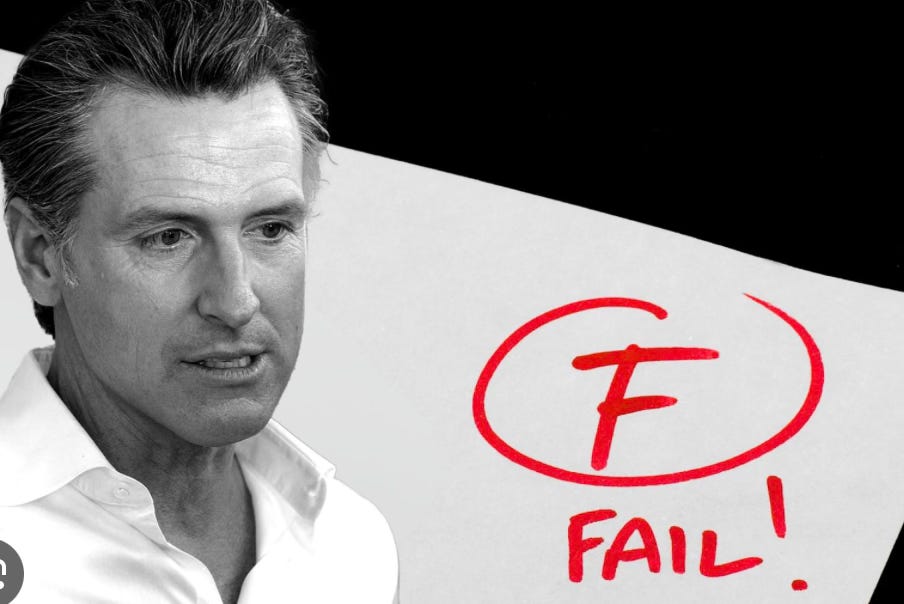
The most amazing recent item about the incompetence of the progressives who have taken over California concerns the political incompetence of Gov. Gavin Newsom. Yes, I know this suggestion will come a shock to many readers.
As most everyone knows, there is a billionaire’s wealth tax ballot initiative up in November (likely unconstitutional, but save this for another day), which Newsom opposes. Though in a typical straddle and an eye on the DSA ahead of the 2028 presidential election cycle, he has said he would favor it if it was a national proposal, so that billionaires couldn’t flee California for Texas or Florida. Reminds me of an old quip about Jimmy Carter. Someone—I forget who—said, “There’s only two things I don’t like about Carter. His face.”
In any case, his opposition to the initiative proved insufficient to derail it before it reached the ballot. And the Los Angeles Times last week published a very embarrassing story revealing Newsom’s complete incapacity to be an effective political leader.
According to the Times, the SEIU union that sponsored the initiative was not serious about going to the ballot with it, but envisioned it as a bargaining chip to get Sacramento to commit more funds to its constituency. Last month Newsom met with the SEIU chief, Dave Regan, to see if he could reach a deal to get the SEIU to pull the initiative. It didn’t go well.
The Times:
The terms Regan allegedly laid out raise the question of whether he intended for the billionaire tax to go on the ballot, or if it was designed as a leverage play to expand his union, which represents more than 120,000 workers and is among the largest healthcare unions in the nation.
Regan, who has been elected to five consecutive terms as union president since 2011, has a record of launching ballot initiatives at the state and local level to use as leverage for union expansion and to thwart his political opponents. . .
“It’s no secret in Sacramento that the ballot initiative has been used this way by UHW as a weapon,” said Francisco Silva, president of the California Primary Care Assn., which represents community clinics. “They’ve been very vocal about it and we think it’s a bigger risk to the safety net than any benefit that it brings.”
His opponents say his strategy centers on launching initiatives that would hurt employers, which forces them to come to the table to negotiate. Regan’s union then requests union contracts or other concessions that could pave the way for a collective bargaining agreement. If employers resist, the initiative advances to the ballot. Voters consistently reject his measures, but companies still spend millions of dollars campaigning against them.
Newsom is reported to have offered $7 billion to the SEIU and its UHW affiliate, but this is a fraction of what they want.
What the Times misses is that a previous generation of Democrats such as Jerry Brown (yes, even Moonbeam Jerry) or Gray Davis would have shut this initiative down not by bribes of public money but but threats to eviscerate the SEIU in a thousand different ways (and in fact the rest of organized public sector unions in California are furious with the SEIU over the initiative). Those guys, for all their defects, knew how to use political power. The lesson here is another data point is just how bad a politician Gavin Newsom really is. A data point to keep in mind for 2028.
But that’s not the worst news. Just a couple months ago people wee buoyed by some polls suggesting Republicans might sweep the top-two spots for governor, with strong numbers for Steve Hilton and Chad Blanco, and divided Democrats were in a panic about this. But Dems sorted themselves out and united behind the mediocre Xavier Becerra, and Hilton finished a strong second. We were also excited by the Spencer Pratt campaign in Los Angeles, and it looked like he might win or at least make the November election. That hope was dashed with California’s usual Ugandan-style vote-counting system.
But even worse are the results of the latest Public Policy Institute of California (PPIC) poll, which shows that a majority of Californians have apparently lost their minds. (Let me state here that I think the PPIC poll is pretty good, and not deliberately skewed in a left direction.)
Some lowlights from the findings:
• Xavier Becerra (D) leads Steve Hilton (R) by a wide margin (61% to 36%) in the governor’s race. Democratic candidates lead Republican candidates in local House district races (63% to 35%). A majority of likely voters say that candidates’ positions on the environment are important in determining their vote.
• About half approve of Governor Newsom while one in four approve of President Trump when it comes to their handling of environmental issues.
This one really tears it:
• Seventy-five percent of Californians think that the Global Solutions Act of 2006 that required California to reduce its greenhouse gas emissions has been mostly a good thing for California. Majorities of adults believe that the effects of climate change have already begun, and that they pose a serious threat to the economy and quality of life of California’s future. Fifty percent say that they are very concerned that home insurance will become more expensive due to climate change risks. About two in three favor the state government making its own policies separate from the federal government on climate change. Six in ten favor requiring that all electricity come from renewable energy by 2045, while six in ten are not willing to pay more for renewable energy.
• Eighty-two percent of adults think the California Coastal Commission that was established permanently by the California Coastal Act of 1976 has been mostly a good thing for California. Large majorities continue to oppose more oil drilling off the California coast and favor wind power and wave energy projects off the California coast.
So if Californians apparently want to keep paying the highest prices for gasoline and electricity, even though it isn’t necessary and won’t do squat for the climate (even if it was in danger, which it ain’t), and likes the Stalinist Coastal Commission.
California has become a museum-grade study in H.L. Mencken’s famous quote that “Democracy is the theory that the common people know what they want, and deserve to get it good and hard.” With public opinion this far in the bag for progressive cliches, there isn’t much hope a voter revolt will happen any time soon.
Gooder and harder, California. The beatings will continue until morale improves.
There is one good piece of news from California on the transportation front: President Noisome...er, GOVERNOR Noisome, excuse me, has announced a new public/private partnership to get the California Choo-Choo project back on track(well, not back on track, since it'a never been on track, but on track). The new initiative will be know as the B,F & MH RR(Boondoggle, Featherbed and Money Hole Railroad), and the partners will be the Nation/State of California, the Quality Peoples Transportating Company of West Mogadishu, MN, and Local 666 of the IAJSG&H (International Association of Journeymen Swindlers, Grifters, and Highbinders). The first crucial step is the awarding this week of a $38B contract for printing the timetable to the Right Gude Inglish Translational Corp. of Hu Boi, China.
As a four decade Arizonan, I want a high and wide border fence with our neighbor to the west.
Double walled, 30 ft high, with deep rolls of concertina wire between them. Armed AZ Nat'l Guard in turrets defending my state.