

Five years ago over on Power Line I posted an item reporting on how the American Political Science Review (APSR), the premier journal of academic political science (getting published in the APSR is usually an automatic ticket to attaining tenure for a young academic), had installed to great fanfare an all-female editorial staff. Of the 12 women appointed to the editorial staff, 11 were clearly part of the woke “race & gender” collective. (The bios of all 12 can be found on the Power Line post linked above.)
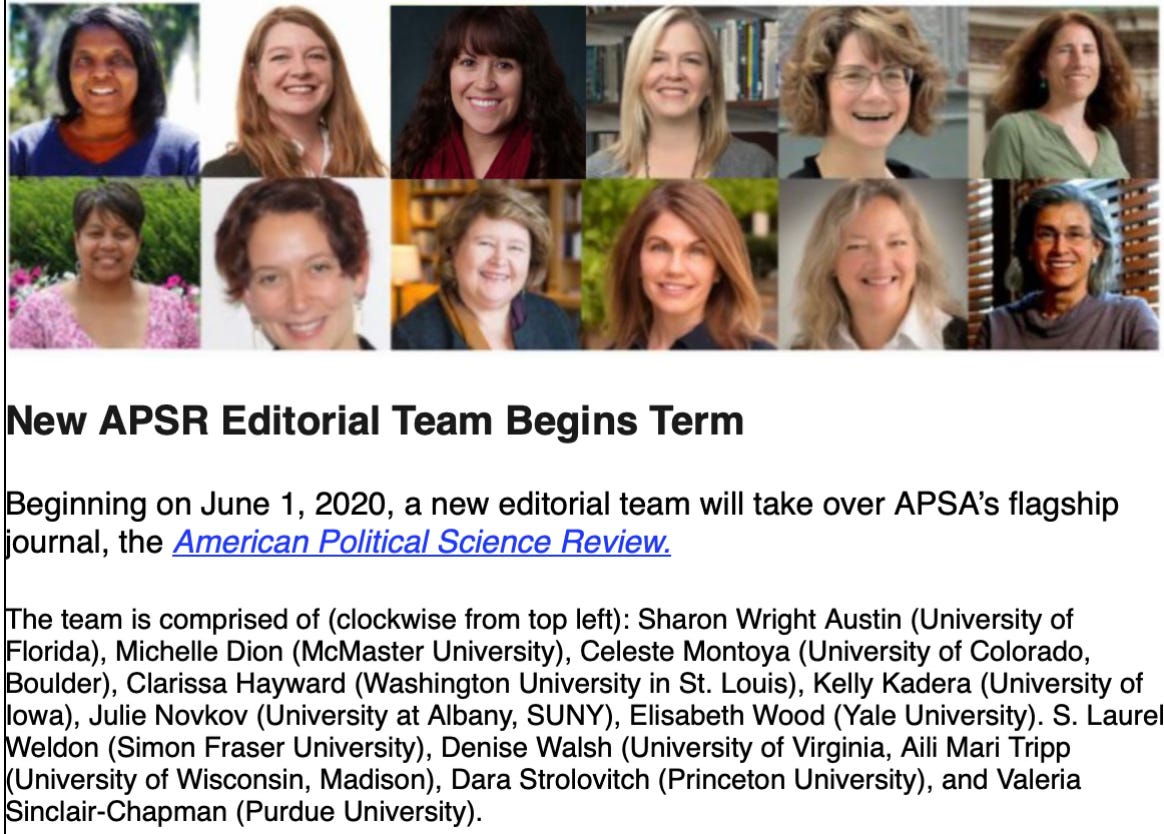
The APSR boasted at the time about its “substantive and methodological breath and expertise,” but in fact it was predictably narrow both in methodology and ideology.
Yesterday the Goldwater Institute in Arizona published an evaluation of how it has gone at the APSR over the last five years, “Peer Review Gone Wild: Flagship Political Science Journal Shows How Academic Gatekeepers Promote Ideology Over Scholarship. It is a terrific piece of work. Some highlights:
Despite functioning as a de facto gatekeeper of publicly funded research in political science, the editorial team of the APSR from 2020-24 labeled itself “the Feminist Collective,” explicitly declaring that the discipline of political science needed “to actively dismantle the institutionalized racism, sexism, heterosexism, ableism, and settler colonialism that continue to characterize and structure it.”
The Feminist Collective promised to institute a two-tiered system of standards, actively screening submissions differently based on the authors’ race and sex. Submissions from women and “scholars of color” would be almost automatically advanced to the peer-review stage regardless of quality, while articles written by scholars outside of these categories were subjected to potential “desk rejection” review before being advanced.
The journal’s editors actively favored submissions steeped in an ideologically charged policy agenda, explicitly calling for articles focused on “pressing political problems, including structural inequalities and the exercise of power by oppressed people,” along with “policing and the carceral state, [and] racialized and gendered health and economic inequalities.”
Here’s the finding of most interest to me:
Thanks to the APSR’s editorial manipulation, from 2020-25, only three APSR articles (less than 1% of the total articles published) specifically focused on the U.S. Constitution or the 50 state constitutions. The number of articles focusing on race, gender, and/or social justice was more than 40 times greater than the number focused on American constitutions, with nearly one-quarter of all APSR published articles examining race, gender, systemic oppression, or related topics.
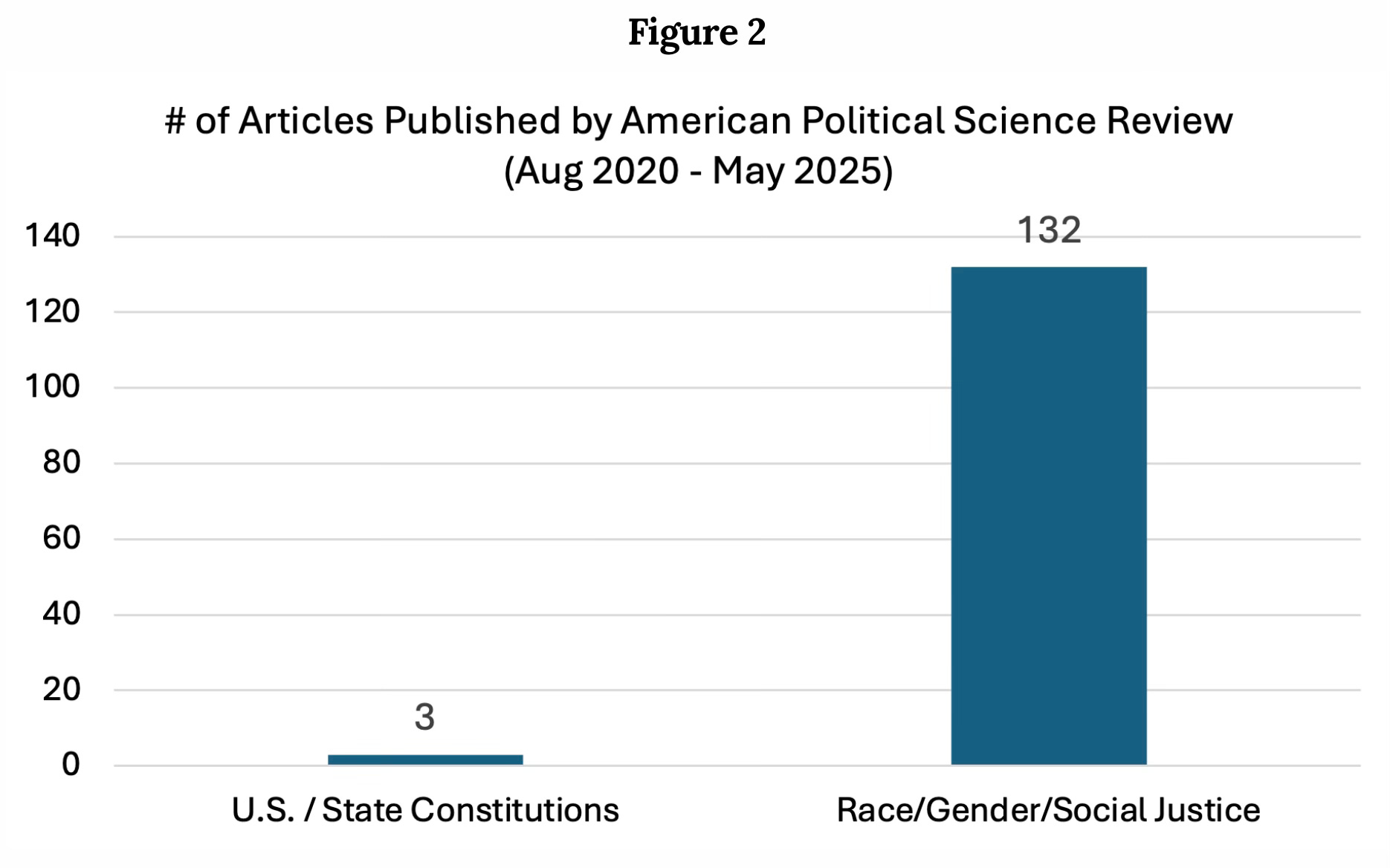
You would think that the Constitution, and public law more generally, would be of pre-eminent interest to the leading journal of the field. In fact, for decades the APSR not only featured many important articles about constitutionalism (like Martin Diamond’s widely noted 1959 article on The Federalist), but for several decades the APSR ran a special section in each issue on constitutional issues at the state level. That is long gone. I have some unfinished research, complete with histograms and the whole bit, tracing out the decline of the APSR’s inclusion of constitutionalism and public law in its pages, and I’ve had more than a few liberal political scientists admit that this is a defect in the discipline.
I have been a critic for a long time of the regression-model quantitative obsession that now dominates academic political science, but I’ll save that rant for another time. Here though I will drop in for comparative purposes from excerpts from Peter Odegard’s 1951 address to the American Political Science Association’s annual convention. Odegard was APSA president that year, and was the long-time chairman of Berkeley’s highly rated political science department.
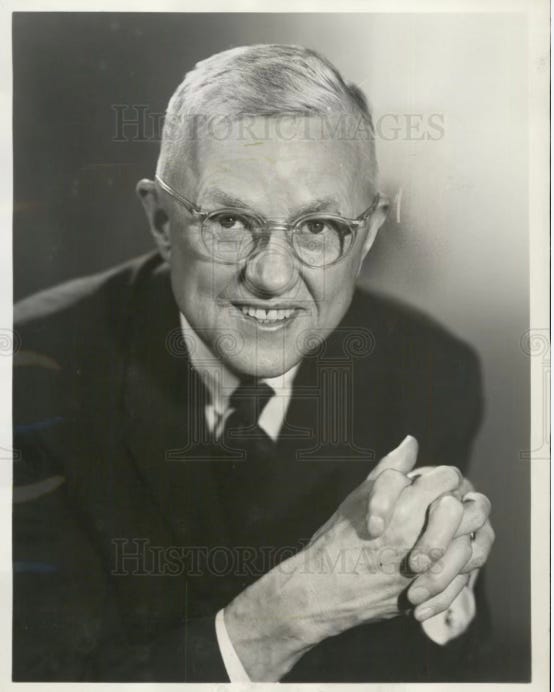
After taking note of a supposedly archaic text on politics from the time of the founding, Odegard said:
If one is to argue that such training [as was taught to the American founding generation] is a poor preparation for practical politics, at least he must admit that it did not seriously handicap Jefferson and Madison, Hamilton and other practical politicians, who became the architects of democratic government in the modern world. Indeed, one may well ask whether the Declaration of Independence, the Constitution, or the Federalist Papers could have been written except by men trained in this way. We might well ask ourselves also where in America we are today preparing the Jeffersons, the James Wilsons, the James Madisons or Alexander Hamiltons that our world so sorely needs? . . .
Graduates emerge from our colleges who are moderately well “trained” in this skill or that, but lack even the rudiments of an education. This progressive impoverishment and fragmentation of human knowledge has not only made a mockery of anything worthy to be called a liberal education but has also undermined the common core of knowledge and training in science, history, literature and philosophy that had been a bond of union among educated men and women for a thousand years. . .
Much current literature seems to be based on the theory that politics becomes scientific by becoming polysyllabic and obscure. New and strange vocabularies have emerged. It is as though some scholars-usually strangers to the city hall, county court house, state or national capitol find sublimation in a kind of Semantic Nirvana. One of them, for example, writes about the importance of diversity of “interaction patterns” “to a working conceptual scheme, including. . . the segmental chain reaction patterns of greatly varying extent of political distance, and the segmental interlapping patterns where there is in effect the paradox of a discontinuous continuum.”
Of course, Odegard wrote this long before the arrival of tendentious identitarian ideologies.
To return then to the Goldwater Institute study, behold a discipline that, to go by the APSR, has been destroyed. (More likely what has been destroyed is the APSR.) The APSR’s editorial team actually called itself “the Feminist Collective.” So we shouldn’t be surprised to find things like this:
The Feminist Collective committed to promoting research that focused on various identity categories (race, gender, and sexual orientation) and the oppression of various groups defined by these categories. They proudly noted their commitment to “equity.” And they expressed interest in studies of “structural injustice” and endorsed the goal of “dismantl[ing] … settler colonialism.”[xxxiii] To examine the prevalence of research on these topics, Goldwater reviewed each abstract (the summary of an article’s claims and evidence) for all 549 articles published in the APSR during the review period. We noted the abstracts that discussed one or more of the following topics:
Race or ethnicity
Gender
Sexual orientation
Colonialism, postcolonialism, or decolonization
Systemic oppression or structural injustice
Equity
The entire study is worth it for the Appendix alone, which tabulates titles and abstracts of ridiculous articles that previously you had to look for in third-tier online journals that no one reads. I’ll limit myself to just one:
Title: “Instrumentally Inclusive: The Political Psychology of Homonationalism”
Abstract:
“The sustained advance in pro-LGBT+ attitudes in the West often contrasts with the greening of anti-immigrant sentiment propagated by nativist supply-side actors. We argue that these parallel trends are causally connected, theorizing that exposure to sexually conservative ethnic out-groups can provoke an instrumental increase in LGBT+ inclusion, particularly among those hostile toward immigration… In a context where sexuality-based liberalism is nationalized, increasing tolerance toward LGBT+ citizens is driven by a desire among nativist citizens to socially disidentify from those out-groups perceived as inimical to these nationalized norms. Our analyses provide a critical interpretation of positive trends in LGBT+ tolerance with instrumental liberalism masking lower rates of genuine shifts in LGBT+ inclusion.”
I’ll spare you any more of this. APSR: RIP. Even Woodrow Wilson (the first president of the APSA back in the 1890s) would be appalled.
"Does this compendium on systemic oppression and structural injustice in postcolonial or decolonized ecosystems make me look fat?"
The deterioration of all such organizations in this country follows on the heels of what I saw in public education beginning in the early 1970s, although its roots may go back further than that. A few years after I started teaching in the Special Education department of Seattle Schools the founder and head of Special Education, Roy Howard, retired. The person chosen to replace him had been one of his consulting teachers, Charlene Berens. Berens first act was to begin staffing the entire upper echelons of the department with women friends of hers with whom she had attended graduate school at the University of Washington. It was a straight line shot from there down a steep grade. I managed to steer clear of that group for many years. Then a couple of years before I retired I made the mistake of attacking one of the "enlightened ones" after she thoroughly embarrassed me and herself by lying to a parent and to me during a IEP conference. I said nothing to her during the meeting, but wrote a scathing email to her the next day. I never again possessed the golden boy status I had for more than 40 years. I had attacked a sacred cow, committed the ultimate heresy.
I have watched over the years since retirement as more and more institutions have gone down that same road in which entire curricula and management have been redone to satisfy some political agenda based on race and gender. I had hoped that the rest of society would have greater resilience, but, alas, like dominoes falling the deterioration continues, most notably in medicine which is more than a bit scary. Why then shouldn't Political Science follow the trend?