
The Declaration, Take 1
Getting Ready to Rumble Again on July 4

I’m back in the new “Postscript” section of the New York Post again today, with the first in a series of articles I’ll be running there between now and July 4 on the Declaration of Independence, and especially looking at some of the flood of new or recent books about the Declaration for what they can tell us about its status and understanding in the American mind.
This first essay looks at a few older books stretching back to the 19th century, and ending with a book published more than 10 years ago. There are a ton of books and perspectives to be taken in during this series, some of them not yet out (I have the advance prepublication galleys for two excellent ones on my desk right now).
For the moment this piece is a bit hard to access, but will come out from behind the Post’s filters and paywalls in a few days, at which time I’ll send out a new notice. In the meantime, if you just can’t wait to see it, you can get access through the green button to read it on the Post’s “Press Reader” pop-up here.
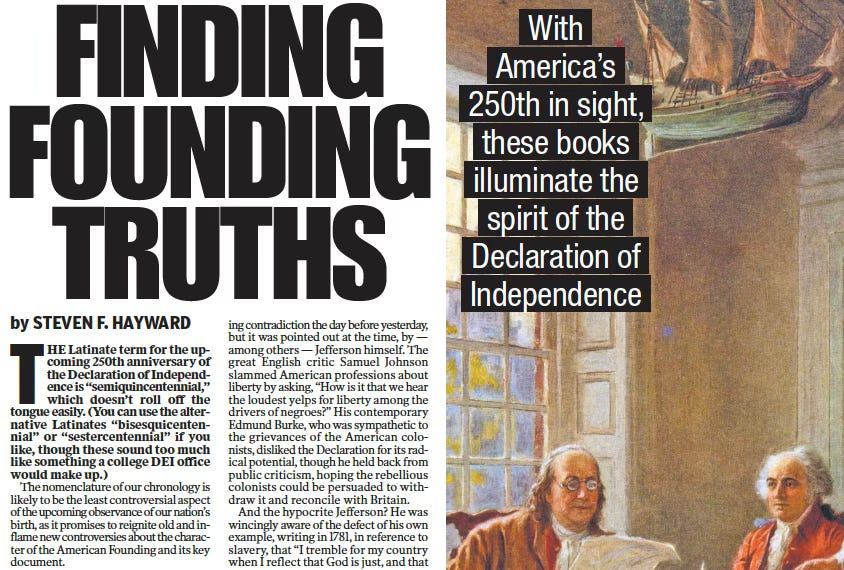
One excerpt:
As was the case at the bicentennial in 1976, the pageantry on July 4 will include a large flotilla of “tall ships”—replicas of the grand colonial era wooden ships with elaborate rigging—sailing up the Hudson into New York harbor. It is likely that if Kamala Harris were president now instead of Donald Trump, the observance would feature a flotilla of slave ships instead, so ingrained has the repudiation of the American Founding become among the identitarian left. Don’t put it past Mayor Zohran Mamdani to attempt to slip some in.
The piece also discusses Carl Becker’s influential 1922 book on the Declaration, which was considered definitive for many decades, correctly so as Becker established the centrality of John Locke’s Second Treatise of Government as a primary inspiration for the logic of the Declaration. But. . . Becker was a Progressive who fumbled his ending.
My article in the Post today contains a compressed treatment of this issue because of the ordinary space constraints of newspaper that command brevity. Immediately below is how I discussed Becker in my book about Harry Jaffa and Walter Berns.
Perhaps the best example of how the historicism of German philosophy had permeated American thought is found in the later Progressive Era historian Carl Becker. In his justly regarded 1922 book The Declaration of Independence, Becker wrote in conclusion that “To ask whether the natural rights philosophy of the Declaration of Independence is true or false is essentially a meaningless question.” Meaningless, because History and Progress had replaced nature as the ground of political thought. The faith of the founders, Becker concluded, “could not survive the harsh realities of the modern world.”
Yet Becker also provides the portal to the problems of mid-century liberalism, as Jaffa was to observe much later. When the “harsh realities of the modern” world took horrific shape over the next two decades, a confused Becker backtracked. Becker published a new edition of The Declaration of Independence in the fall of 1941, in the shadow of the European and soon to be American war, and struck a very different note in a new introduction:
[It] may be thought that just now, when political freedom, already lost in many countries, is everywhere threatened, the readers of books would be more than ordinarily interested in the political principles of the Declaration of Independence. Certainly recent events throughout the world have aroused an unwonted attention to the immemorial problem of human liberty.
Suddenly, the principles of liberty, taken for granted as simple and solved by Woodrow Wilson and other Progressives, had returned as an “immemorial problem” in need of foundations. To continue with Becker:
The incredible cynicism and brutality of Adolf Hitler’s ambitions, made every day more real by the servile and remorseless activities of his bleak-faced, humorless Nazi supporters, have forced men everywhere to re-appraise the validity of half-forgotten ideas, and enabled them once more to entertain convictions as to the substance of things not evident to the senses.
The ideas Becker identified as “half-forgotten” were only so because of a self-willed forgetfulness.
As we draw near to July 4 this summer, there will be deliberate attempts by the left to reintroduce this kind of self-willed forgetfulness. We’ll have a lot to say about it here on Political Question, in the NY Post, and elsewhere.
Footnote: Jaffa discusses the deeper background of Becker and Becker’s turn in chapter 2 of A New Birth of Freedom: Abraham Lincoln and the Coming of the Civil War (Rowman & Littlefield, 2000), esp. pp. 96 – 121.
Without resorting to a single naughty word or even mentioning the word "fat", this sentence (paraphrased and updated) from historian Carl Becker characterizes the Left, particularly the women, to a T:
"the servile and remorseless activities of [the] bleak-faced, humorless [left-wing totalitarian and anti-Semitic supporters...]"
Now paid for by billionaire divorcees and that singular pustule on the hind-end of America, George Soros. I give you Kathy Griffin, Katie Porter, Rosie O'Donnell, Whoopi Goldberg, Barbra Streisand, and the entire Squad, plus the mayors and Fire Chiefs of every Blue City and State -- a Rainbow Coalition of mental illness as "bleak-faced" as anyone I would want to see.
AG
It's hard to name a country, including ours, where the immediate, thorough application of the Declaration's principles would not help straighten things out. But the citizens have to shape up.