
Notes from Upstream: "Uncle Scrooge"
Celebrating the legacy of Carl Banks

Does this comic book panel look familiar?
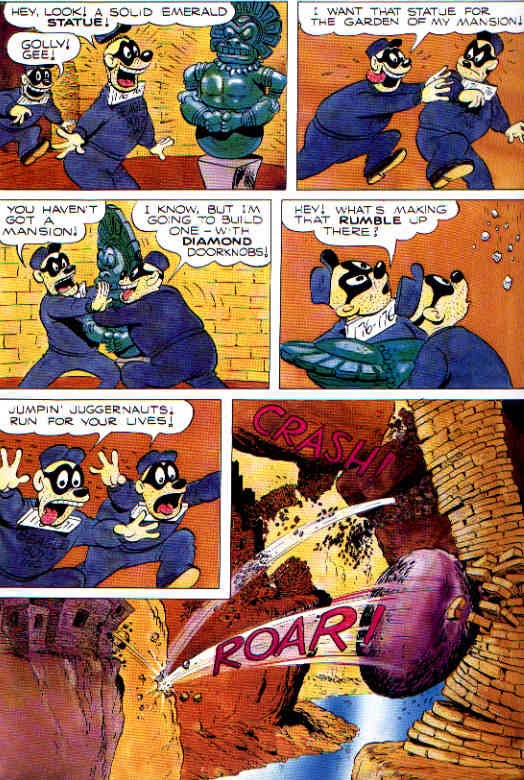
Does this help?
In 1981, Edward Summer was editing this monumental volume, of which I am a proud owner:
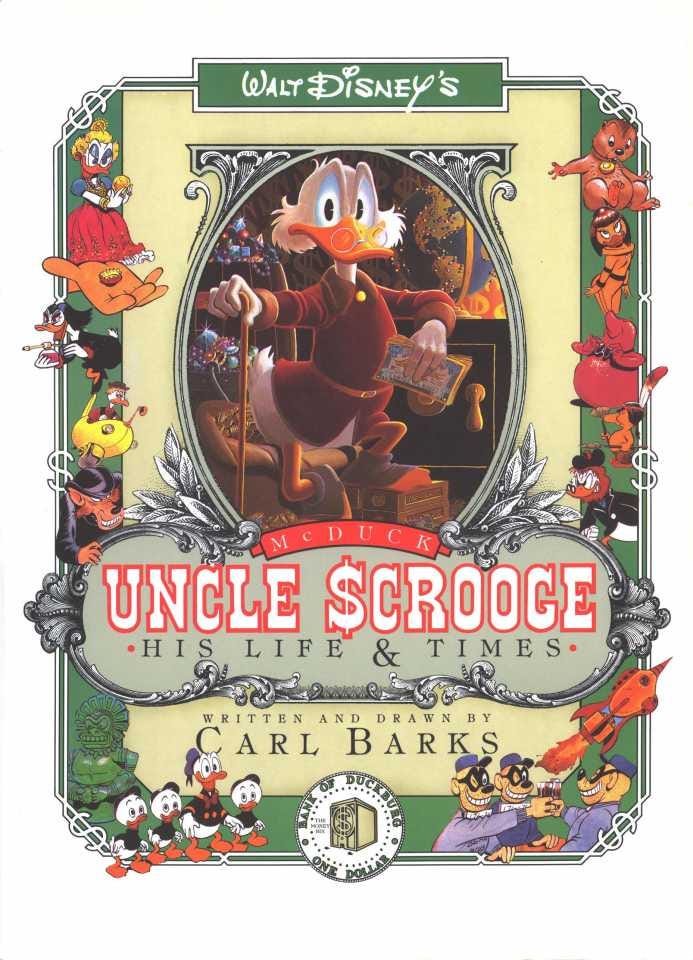
In the course of his work, Summer interviewed George Lucas, one of the writers on the movie that clip was from, Raiders of the Lost Ark. Summer pointed out the similarity in the two scenes to Lucas, who told him the boulder scene in Raiders was a conscious homage to the boulder scene from the Uncle Scrooge comic book story, 7 Cities of Cibola (1954).
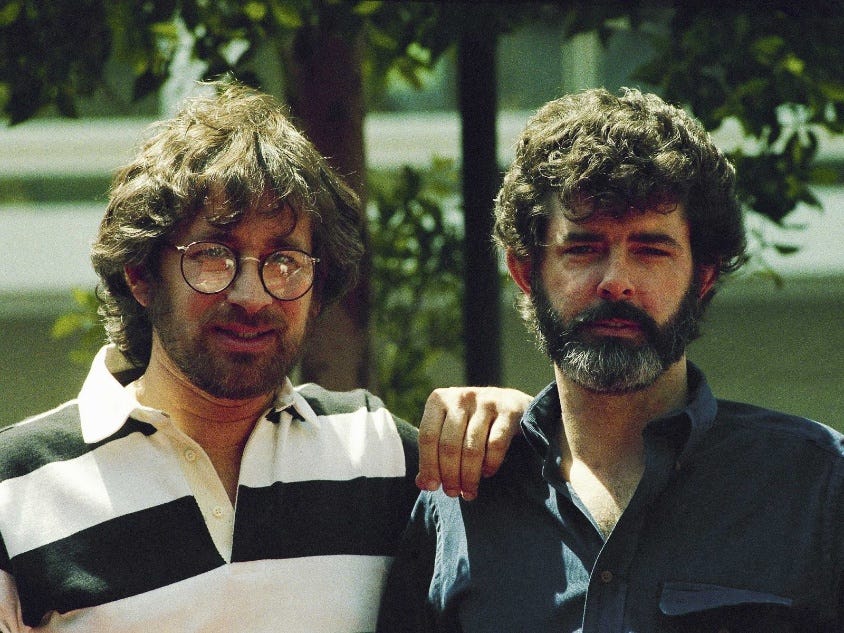
Lucas and his good friend Steven Spielberg, who directed that movie, grew up reading Uncle Scrooge comic books.
As did I.
In fact, I keep running into people who did likewise. I bet some are among our commenters.
I learned to read a little in school (“See Dick Run. Run run run”), but I learned to read stories from Uncle Scrooge Comic books. After all, before I could read Shane or Heinlein novels, or Tolstoy or Henry James for that matter, I had to learn to follow the plot.
By the way, by comic books, I don’t mean “graphic novels.” We were kids and too plainspoken to come up with so pretentious a characterization
Most of the comic books I read were the “Funny Animals” variety. For example, we had Looney Tunes.
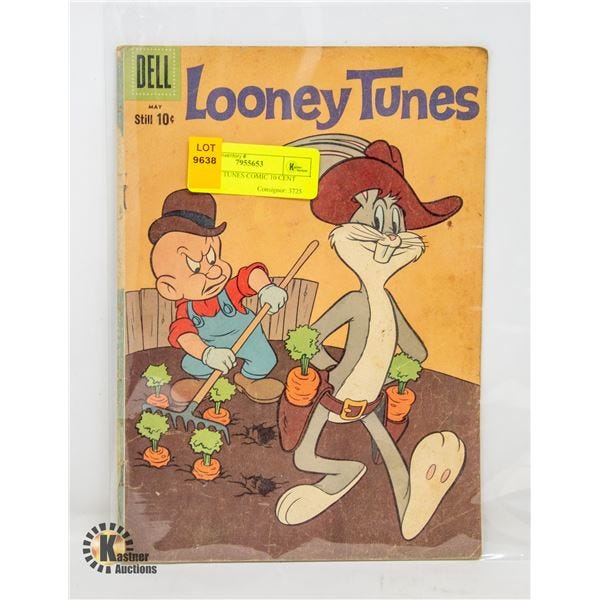
Not a digression: during WW2, the U.S. Marines designated Bugs Bunny an honorary Marine private. They issued him dog tags and registration papers and promoted him several times. At the end of the war, they gave him an honorable discharge with the rank of Master Sergeant.
Occasionally I picked up a copy of Tom and Jerry.
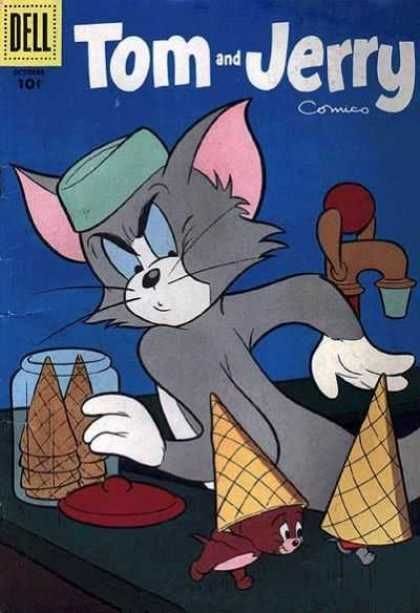
I wasn’t the only one. Dell Comics published not only Walt Disney comics like Uncle Scrooge, but Warner Brothers’ Looney Tunes, Tom and Jerry and others. In 1953, Dell's total monthly circulation reached over 30 million copies. That year, they sold 375 million comic books.
Donald Duck was bimonthly. Its circulation approached two million. Every quarterly issue of Uncle Scroogesold an estimated 800,000 to 1,000,000 copies.
Why?
I can’t speak for others, but I loved the ripping yarns.
Uncle Scrooge took his nephew Donald and Donald’s nephews Huey, Dewey, and Louie on one wild adventure after another.
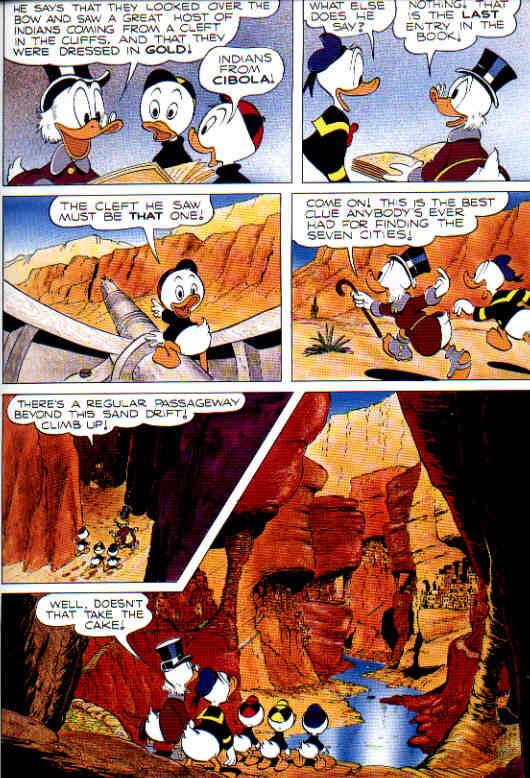
They tracked the trackless deserts of the American Southwest for the legendary 7 Cities of Cibola (1954):
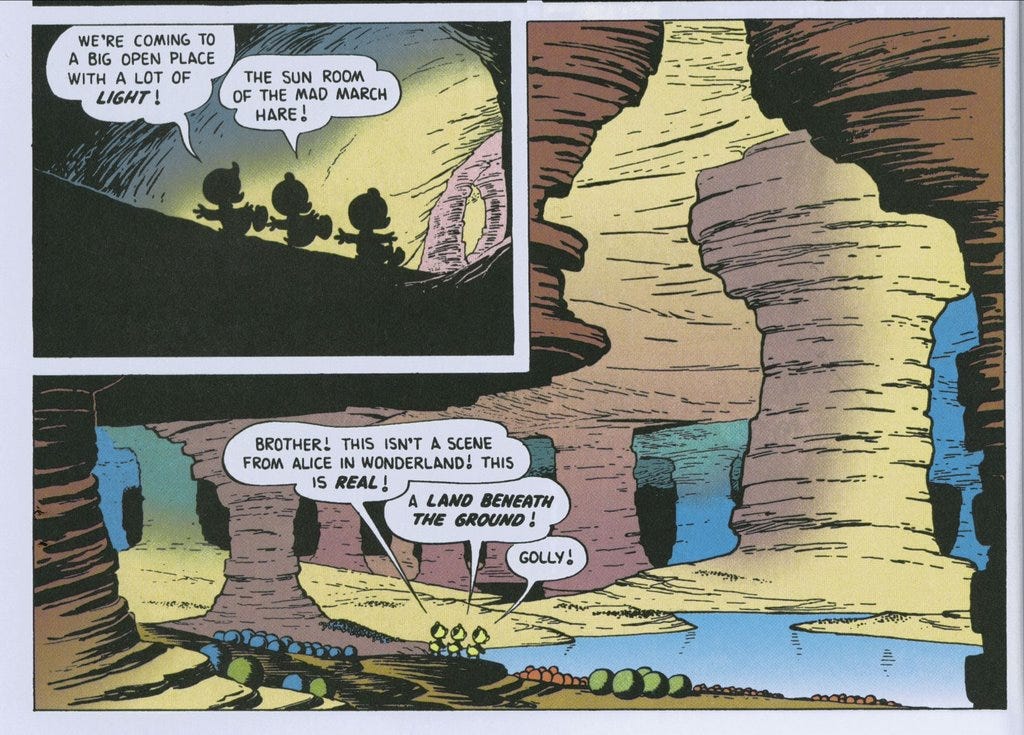
In Land Beneath The Ground!, they discovered a massive cavern underground, where dwell the “TerriFermians” who cause the world’s earthquakes.
In The Lost Crown of Genghis Khan (1956), the five intrepid ducks trekked through the terrain of the snow-capped Himalayas in pursuit of the titular crown, which had been stolen from Scrooge.
Uncle Scrooge didn’t paint only grand scenes, but more intimate moments as well. In Back To The Klondike (1952), Scrooge revisits the site of his gold rush days, where he stands and stammers at the sight of his old girlfriend Glittering Goldie:
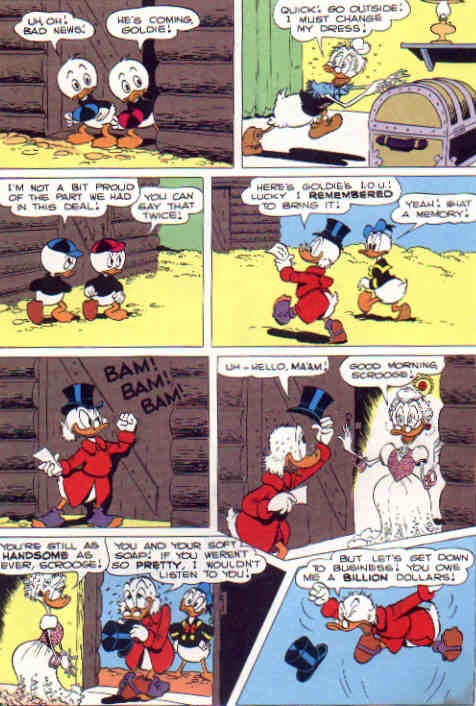
It takes a lot of artistry to paint a convincing flustered expression on a cartoon duck.
In The Golden Fleecing (1955), they’re after the golden fleece. Scrooge wants it in order to get a new coat (never one to waste a dime, he’s still wearing the coat he bought fifty years earlier, in his Klondike youth). The five ducks visit the fabled land of Colchis.
How will they defeat the harpies who guard the place?
Once again, Huey, Dewey and Louie save the day. They rely on the single resource which never fails: The Junior Woodchuck Guidebook and Reservoir of Inexhaustible Knowledge. This book is never wrong. In every tight spot, they pull out their Guidebook and discover the solution: they learn the best way to deal with harpies or how to climb up a slippery mossy embankment or how to befriend the Abominable Snowman.
Another non-digression: some people claim you can distinguish Huey, Dewey, and Louie by the colors of their caps. As a child I wasted hours trying, and no, you can’t. That inconsistency was one of the artist’s little tricks to keep the reader alert.
So who was this artist?
Cue the anonymous genius: Carl Barks.
From 1947 through 1966, one man wrote and illustrated and colored every Uncle Scrooge comic book all by himself, and Donald Duck as well.
Only a handful knew his identity. People called him “the duck artist” or the “duck man.” The Disney Corporation kept him a secret. They insisted on pretending it was Walt Disney personally who created all their comics. It wasn’t until Walt Disney died in 1966 that any significant number of people learned the name “Carl Barks.”
Barks didn’t work in a corporate studio. He created from his house in Hemet, just outside L.A.. Every time he finished a new story, he sent the package to Western Publishing. In exchange, they paid him peanuts.
Barks worked in isolation. He had no awareness of the circulation he was generating. Someone was buying his work, so he kept creating. After all, he was fulfilling his childhood ambition to be a cartoonist.

Hollywood hires committees and consultants to do their “world-building.” Carl Barks built an entire world from home, all by himself.
It was a child’s world, disconnected from reality, but with the general shape of reality.
Included in this world was the town of Duckburg, which contained the famous Scrooge McDuck money bin and its trademark depth gauge. Uncle Scrooge loved to take a dip in his money bin.
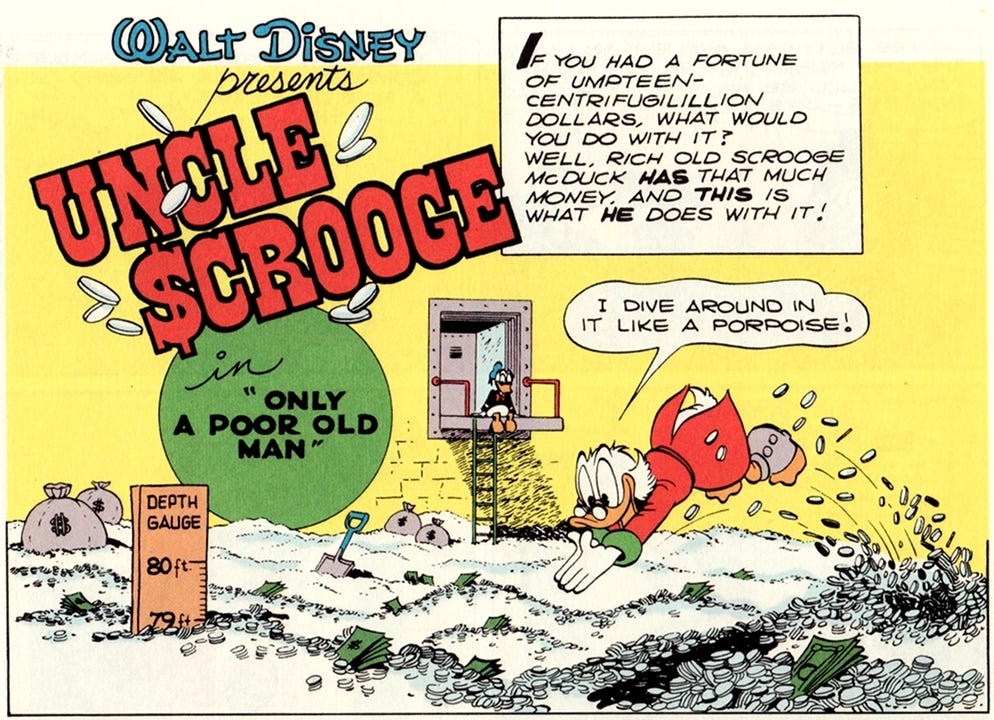
One key ingredient in the Scrooge fantasy world was the absence of parents. Without parents and their meddling, the kids Huey, Dewey and Louie could freely risk death along with their “uncles” Donald and Scrooge in perilous places no sane parents would allow their kids to venture.
It was never 100% clear whose uncle Scrooge was. He was Donald’s uncle, and Donald was uncle to the three kids, but the kids called Scrooge “Unca” too.
I for one took special care not to worry my head about stuff like that. If I did, I’d would have had to ask why Scrooge McDuck wore only a coat and went pantsless out into the world, but Mickey Mouse wore pants and no shirt, or why Mickey Mouse had both a dog friend Goofy who could talk and a pet dog Pluto who couldn’t.
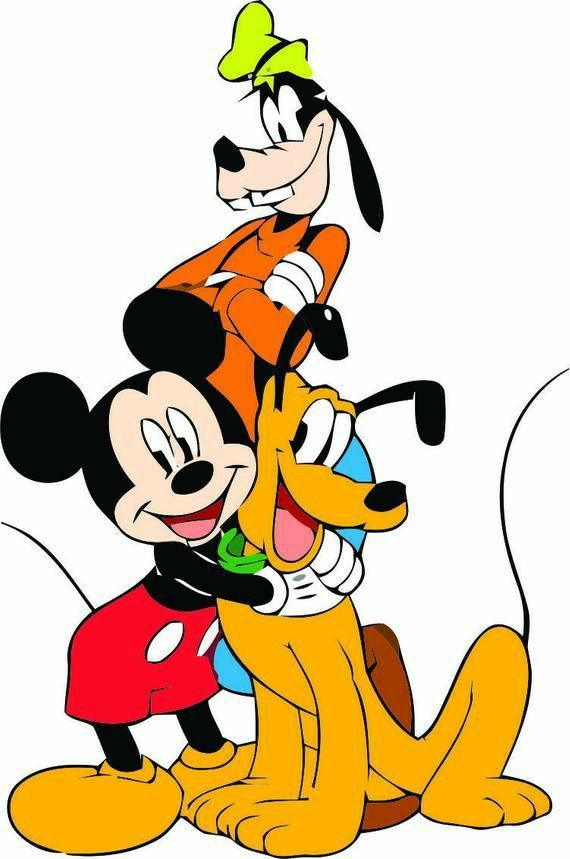
There are threads upon which the discerning reader dare not tug.
Carl Barks kept his world consistent not just for one book or movie, or even a trilogy, but for a series he sustained over two decades, from 1947 to 1966.
One reason for his success was his perfectionist’s attention to detail. He spent hours redrawing and rewriting every picture until he got every detail consistent with his vision.
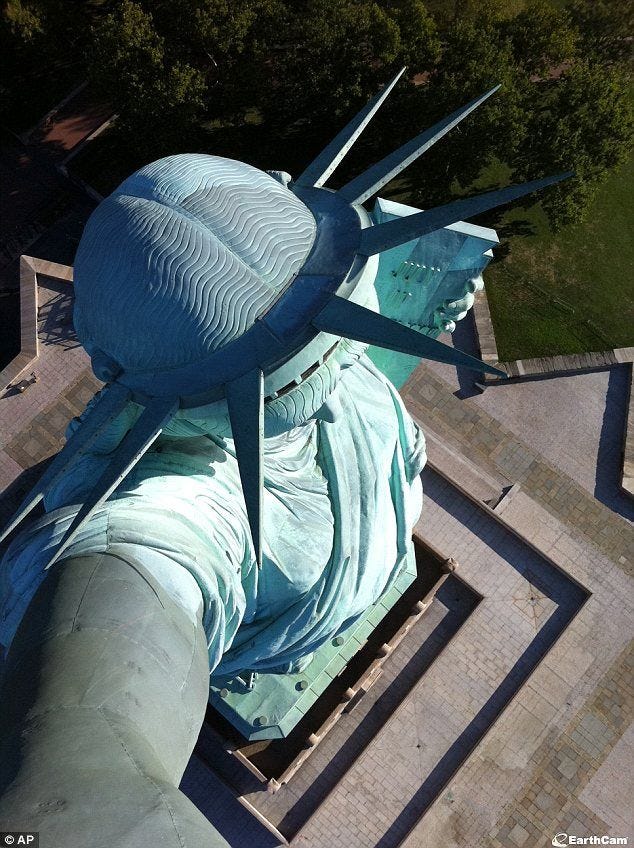
Songwriter and playwright Oscar Hammerstein sought the same perfectionism in his work. Early in his career, he saw a movie taken by a plane flying over the Statue Of Liberty. The sculptors completed the statue in 1886, before the invention of the airplane. Nonetheless the sculptors took care to finish every detail, even the parts they never expected people to see.
When Barks retired at age 65 in 1966, he was broke.
Later, word that Barks was the Duck Man leaked out. He began to receive the recognition and the money he deserved. He was in his seventies.
Conventioneers welcomed him as a hero.
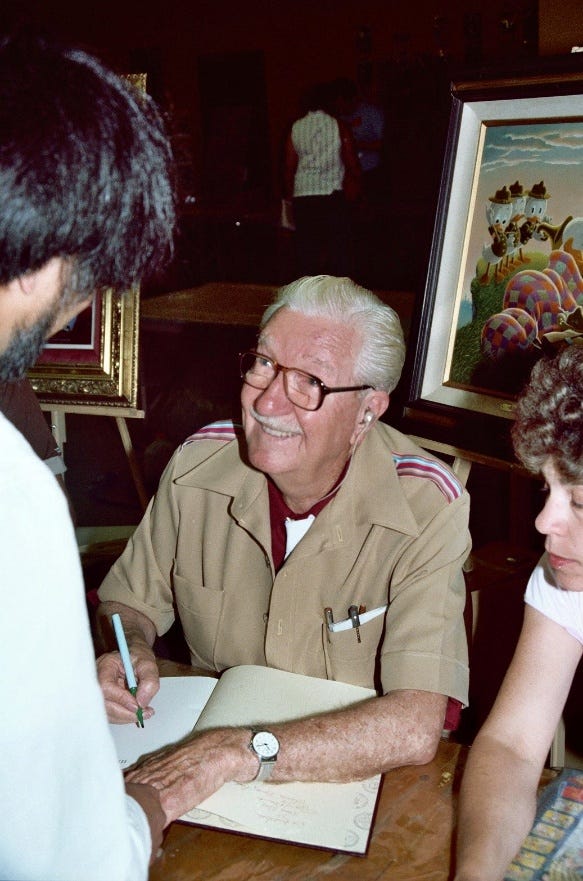
People paid thousands of dollars for his comic book duck oil paintings.
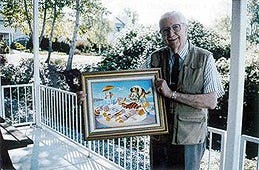
Carl Barks died in the year 2000 at the age of 99, prosperous and beloved.
The influence of Carl Barks lives on.
The master of underground comics R Crumb remembered Carl Barks as "one of those rare cartoonists who could tell a great story, be funny, and draw beautifully...Barks’ duck stories sustained me and my brother Charles throughout our childhoods.”
He and his brother developed their own comic book skills by creating their own homemade Uncle Scrooge comics.
By the 1960s funny animals fell out of style. Now and then I go into a Comics Store and ask about Uncle Scrooge and find nothing. A collection of new superheroes replaced them.
These superheroes continue to clog our culture in an endless stream of pointless Hollywood movies, ever more contrived and more ludicrously expensive.
Of course, the first rule is to have a good story to tell. Spending $300 million on a movie does a studio no good if the studio doesn’t start with a good story.
Here’s a story that’s pretty good: a lone artist labors in obscurity for decades, his identity suppressed by corporate ego and greed. His work spreads far and wide and is loved by millions, but he doesn’t even know it. Finally, in old age, he breaks through and earns the discovery, recognition and prosperity he long deserved. He dies at the ridiculous old age of 99, happy, prosperous and beloved.
Now that’s what I call a good story.
Max Cossack is an author, attorney, composer, and software architect (he can code). He writes his own ripping yarns. One is High Jingo, an “historical, occasionally hysterical, adventure.”
 | A guest post by
|
The sight of Uncle Scrooge's vault -- so deep he could DIVE into the money! -- was quite an inspiration to a kid who brought down a cool quarter an hour for babysitting. I would sit and stare at all that money and wonder what he had done for a living. Definitely not babysitting. I am not sure that I ever even had possessed a twenty-dollar bill until I was in college. I'm not sorry -- I am glad that I grew up appreciating the value of a dollar and working for every penny.
Max, this is off topic unless you allow that you write about writers be they writers of novels, poems, comics books, or songs. But here is my request, I wish you would do a column on compression as in lyric compression. All writers know the weight of their words and use them sparingly, like your comic book writers. All writers especially good lyricists have this ability to tell stories, evoke emotions, transport the listener to another time and place, or strike deep into a listener’s psyche with a few, sometimes a very few, well chose words. What follows are some examples that came to mind to whet your imagination.
My all-time favorite bit of musical transportation was written by: George Gershwin and Rick Wakeman:
Summertime and the livin' is easy
Fish are jumpin' and the cotton is high
Your daddy's rich and your ma is good-lookin'
So hush, little baby, don't you cry…
Boom! By these few lines, by these simple images, the listener is not only transported to an enchanted summer of his youth, he is faced with a conundrum. In his summertime place of memory, he suddenly has to know why baby is crying. An Arcadian pastoral should never be shattered by tears and wailing. The hook is in and our listener must hear the whole song.
Like your comic books another all-time classic, imprinted on every American child, was written by Harold Arlen and E.Y. Harburg (not to mention Ira Gershwin, whose contribution you mentioned a few weeks ago, which got me thinking about this topic):
Somewhere over the rainbow
Way up high
There's a land that I heard of
Once in a lullaby…
Anyone who has seen the movie or had the pleasure of listening to Judy Garland sing these words knows the song and relates to it, because it transports the listener to comfort, mother, and intimate moments shared with a trusted loved one evoked by the word lullaby.
As comforting as the above lyrics are, our comfort can also be shattered. All we have to do is turn to Paul Simon and hear:
Hello darkness, my old friend
I've come to talk with you again…
Instantly we are locked into loneliness or even into the darkest moment of our lives. Ironically, this, too, is a hook, and we must listen to the end of the song, because a good lyrist may walk the listener into darkness, but will never leave him there.
Even some hard-rock songs can produce good bits of compression. As an example, allow me to cite Jimmy Steinman’s Bat out of Hell:
The sirens are screaming and the fires are howling
Way down in the valley tonight
There's a man in the shadows with a gun in his eye
And a blade shining, oh, so bright
There's evil in the air, there's thunder in the sky
And a killer's on the bloodshot streets…
The listener is now in a place where he would rather not be, because it’s creepy, discomfiting, and likely dangerous. But as with “hello darkness” above, he must listen his way out of the horror.
Now, compare those lyrics with Mack the Knife, credited to: Bertolt Brecht, Marc Blitzstein, and Kurt Weill
Oh the shark, babe, has such teeth, dear
And it shows them pearly white
Just a jackknife has old MacHeath, babe
And he keeps it out of sight
You know when that shark bites with his teeth, babe
Scarlet billows start to spread
Fancy gloves though wears old MacHeath, babe
So there's never, never a trace of red…
Brecht et al are far more subtle, less direct, in their presentation of horror than Steinman. Indeed, their words are almost inviting in that there’s “never a trace of red.”
One of my great favorites, and it’s because I love Frank Sinatre, is Summer Wind, Written by: Johnny Mercer, Henry Mayer, and Hans Bradtke
The summer wind came blowin' in from across the sea
It lingered there to touch your hair and walk with me
All summer long, we sang a song
And then we strolled that golden sand
Two sweethearts and the summer wind…
Anyone who knows anything about Frank Sinatra and Ava Gardner, on hearing these words, can see them strolling that “golden sand” and wonder where it all went wrong. It was a love that blew away like the summer wind. It’s a universal experience I dare say.
Lastly, I cannot leave this topic without quoting my late, great compatriot Gordon Lightfoot. I offer this compression of history from the last chorus of the Canadian Railway Trilogy without comment:
Oh, there was a time in this fair land when the railroad did not run
When the wild majestic mountains stood alone against the sun
Long before the white man and long before the wheel
When the green dark forest was too silent to be real
When the green dark forest was too silent to be real
And many are the dead men
Too silent to be real.
Max, I am only citing a few lyrical passages that came to my mind, and I am sure you have much more to add to this discussion. Call me greedy or hungry, but I would love to read what you have to write on this topic.