
Midweek Notebook
Some announcement and previews; some notices and memorials

• First up, a MAJOR ANNOUNCEMENT: Since we missed last week’s regular 3WHH podcast on account of my internet access difficulties and scheduling problems, we’re going to record a special DOUBLE-EPISODE tomorrow (Thursday), livestreamed right here on Substack at 5 pm PACIFIC time. (Subject, as always, to last minute schedule problems) It will be cut up into two audio episodes, but we’ll go 90 minutes or more tomorrow recording both, and will recap the end of the Supreme Court term (“What’s all this about birthmark citizenship,” as Emily Litella might well ask), offering our last semiquincentennial thoughts before July 4 on Saturday, and hopefully answering some listener questions.
If you can’t wait for tomorrow or the weekend for an audio podcast, I have new Power Line Show conversation about the Declaration up this afternoon. Details below.)
• Another ANNOUNCEMENT: I recall back in the late 1980s when the late novelist and critic Richard Grenier wrote that Clint Eastwood’s Dirty Harry was “the first movie that talked back to liberalism.” Of course all the liberal critics like the New Yorker’s Pauline Kael called it “fascist” and worse. Well, comes now Citizen Vigilante, which is going to wear out the censorious vocabulary of the left. Germany and other European countries are trying to ban the film (good luck in the internet age), so it must be hitting its target.
I had hoped to find time to comment on the phenomenon of Citizen Vigilante, but our Max Cossack beat me to it, and has a total banger (as the kids would say) about it tomorrow morning in his weekly “Notes from Upstream” column. I agree with every word of it, including “and” and “the.” Don’t miss it.
The trailer:
• SOWELL MAN: I was traveling all day yesterday from my latest indulgent overseas junket, and neglected to note the 96th birthday of the great Thomas Sowell. He is arguably America’s greatest living “public intellectual” (a term I don’t actually like, but sometimes it fits). His enormous output makes it hard to select one or two pithy quotes to offer up, so I won’t even try. Just check out his “selected books” list on his Wikipedia entry. Naturally the left-leaning Wikipedia alleges that “mainstream” academics don’t pay much attention to Sowell’s books, without entertaining the possibility that they can’t actually refute him (most of the complaints are nit-picking about other data sets), so they adopt the tactic of ignoring him. Good luck with that. People will be reading and replicating Sowell long after his critics are dead and blessedly forgotten.
• My sad news for the week is the passing of Daniel Oliver, at age 87, after a long illness. Former National Review publisher Jack Fowler has a good reminiscence of Oliver at NRO. It prompted my own reflections.
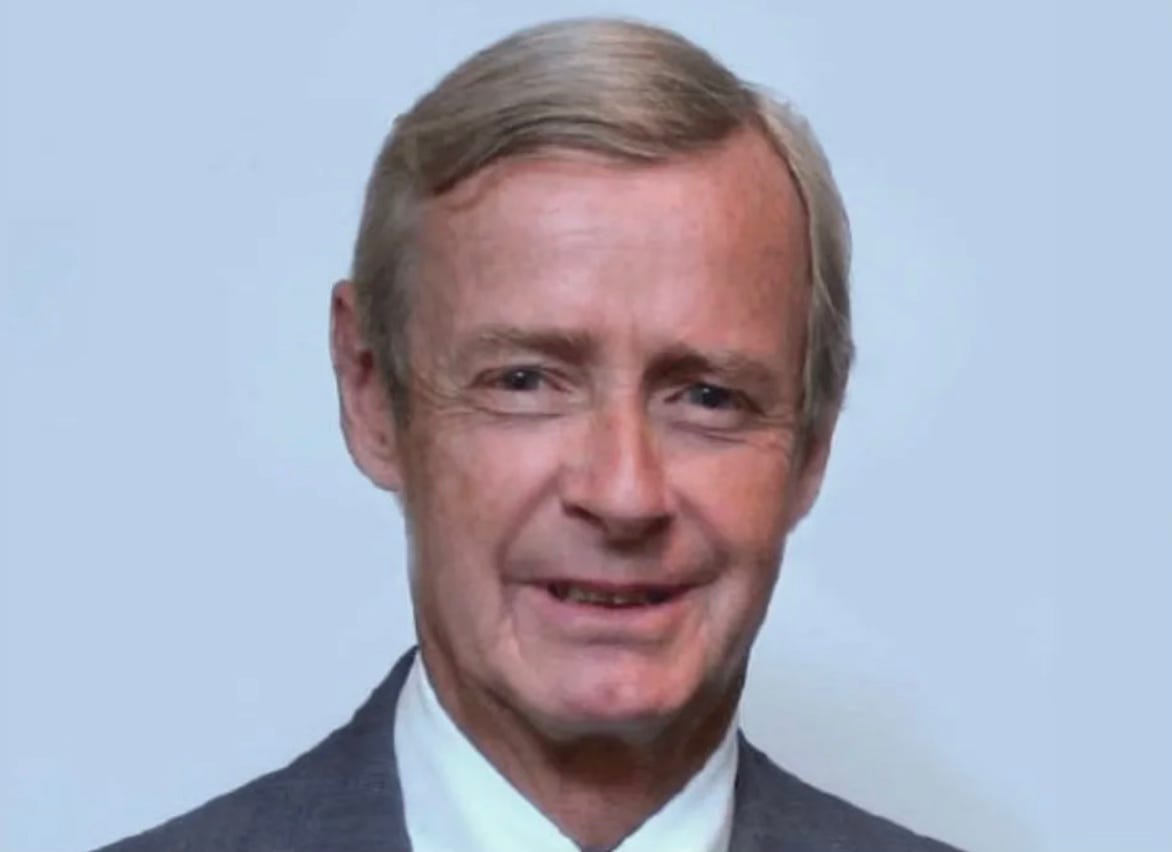
I had lost touch with Dan in recent years, seeing him maybe once a year at the Philadelphia Society annual meetings, but always reading his columns for American Greatness and other outlets. But back in the mid- to late-1990s we were actively in touch. We collaborated for a while on a “Washington Bulletin” for the Pacific Research Institute, which was an attempt to recapture the dynamic of the old National Review Bulletin of the early 1970s (a bi-weekly newsletter that alternated with the schedule of the main magazine), which Dan ran during his time as executive editor at the magazine. Alas I can’t seem to locate any old issues from back around 2000. The modest eight-page monthly had its fans and critics.
As chairman of the Federal Trade Commission under President Reagan, he attacked one of the mandates of the FTC by noting the no-win situation of business: if you charge the same price as your competition, you are guilty of price-fixing and collusion. If you change less than your competition, you are guilty of predatory pricing. Good luck with this regulatory Calvinball. He also used one of his first speeches at the FTC to make the case for why everyone should support the Contras in Nicaragua—not exactly the mandate of the FTC, but what the heck.
When he fired a lot of the FTC staff and drew the ire of the Washington Post for “bringing the FTC to a standstill,” he said “It was my proudest moment. All of my friends called and said, ‘Congratulations! How did you do it?’” But FTC productivity went up, which made Dan realize he either fired the wrong people, or didn’t fire enough people. A template for Trump II perhaps?
In any case, Dan used to say that a true Reaganite deregulator had the disposition of a bride being carried across the threshold on her wedding night, who said: “Don’t just stand there: UN-DO something!”
That was our jaunty Dan.
If you closed your eyes and cocked year ear ever so slightly, his cadences reminded you of Cary Grant. And that made his joke-telling very effective. I recall one evening at dinner with Dan and a very prosperous but rather dull and earnest entrepreneur sharing the progress of the custom yacht he was having built in Italy. It was to be housed first in Palm Beach, and then brought up to somewhere in New England, even though this person lived in California. Dan, who had sailed with Bill Buckley, volunteered to help with the transport. The completely humorless entrepreneur said, “Not necessary—I have a full time captain hired. He knows the waters.” Dan, quick as always, said: “Maybe he knows the waters, but he won’t know what to drink!”
I will miss him. He was one of those persons who brought a big smile to your face the moment you spotted him across the room.
• And for my interim podcast: My final conversation for the Power Line Show with authors of new books about the Declaration of Independence before this Saturday’s formal observance features the co-authors of Divided Over the Declaration: How an Enduring Debate Sustains the Vision of America.
The authors of Divided Over the Declaration are David J. Bobb and Tony Williams, who are colleagues at the indispensable Bill of Rights Institute, and old pals.
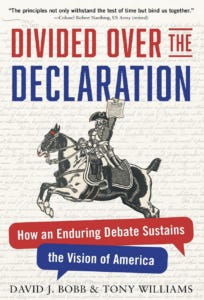
Bobb and Williams have hit upon a unique way to draw our attention to key aspects of the Declaration as it has affected our political history from the beginning. Rather than doing a chronological narrative or analytical account of the sources and ideas in the Declaration, Bobb and Williams highlight several important episodes—you can call them “Declaration moments”—where the Declaration became a central factor in a new debate.
For example, the first chapter takes as its starting point Frederick Douglass’s famous speech “What to the Slave is the Fourth of July?” in 1852. From there the book takes us through the place of the Declaration for the abolitionist movement, Lincoln and the Civil War, the suffragettes, the Progressive era, and of course the modern civil rights movement. The books ends with a story arc from its beginning, with Martin Luther King’s use of the Declaration in his famous speech at the Lincoln memorial in 1963.
The book has a strong concluding chapter that ties the whole picture together with thoughts about the Declaration and our next 250 years.
(Not to worry: I’ll be continuing this series with other authors and thinkers on the Declaration after this Saturday. I just wanted to get one more in before July 4.)
As usual, listen or download here, or at Ricochet when it goes live.
Hope to see many of you at out livestream Thursday evening.
Two birthdays this week; Mel Brooks(100) and Thomas Sowell(96). Happy Birthday, Wit and Wisdom!
Steve, I recently "met" Tony Williams on X (he's a good Syracuse man, class of '92), and he graciously sent me a signed copy of the new book. I am enjoying it very much. As I was reading your missive today I was thinking, "Tony Williams would be perfect for Steve to interview," and then got to the end and saw that you were way ahead of me. They say great minds think alike -- and so do ours!