Herewith a one-stop portal for several items of interest in the news this week. But first an announcement: your 3WHH podcast hosts have the usual scheduling problems again this week, and may either do later on Friday evening around 8 pm Pacific time, or first thing in the morning Saturday, which is when we usually post it up anyway. Probably the latter. Stay tuned here for updates.
• Your Three Whisky Happy Hour podcast hosts have been busy this week. First off, “Lucretia” was provoked (inconceivable! you say!) by Senate Minority Leader Chuck Schumer playing the demagogue about ICE, and produced a spirited commentary for the California Post, “Enough with the gaslighting about ICE”:
Schumer’s portrayal inverts reality: ICE is not a rogue agency but a federal law enforcement body executing the immigration statutes passed by Congress and directed by the elected president.
Its methods –– administrative warrants for civil removal orders, tactical gear including masks for officer protection amid a documented 1,300%+ surge in assaults and 8,000% increase in death threats since the current enforcement push began — are standard for high-risk operations.
FBI hostage rescues, DEA raids on fentanyl labs, and even local SWAT teams routinely employ masks, anonymity, and dynamic entries when facing armed threats or doxxing risks.
Local police are “unmasked” in routine traffic stops, but they do not regularly confront transnational cartels, MS-13 affiliates, or activist networks that publish officers’ home addresses.
More at the link.
Lucretia—provoked by Chuck Schumer?!!?
• Meanwhile, John Yoo is out today at Civitas Outlook with “Justice Scalia, A Decade On,” in particular the late Justice’s focus on restoring the proper understanding of the separation of powers in the Constitution. We discussed this very topic in our last 3WHH. Sample:
Were it not for Scalia’s unique contribution to the Court’s approach to the separation of powers, the Roberts Court’s coming decisions this summer that may strike down virtually all independent agencies would not have been possible. It is difficult to appreciate how the advance of the idea of a unitary executive shows how the pure force of ideas can move the Supreme Court.
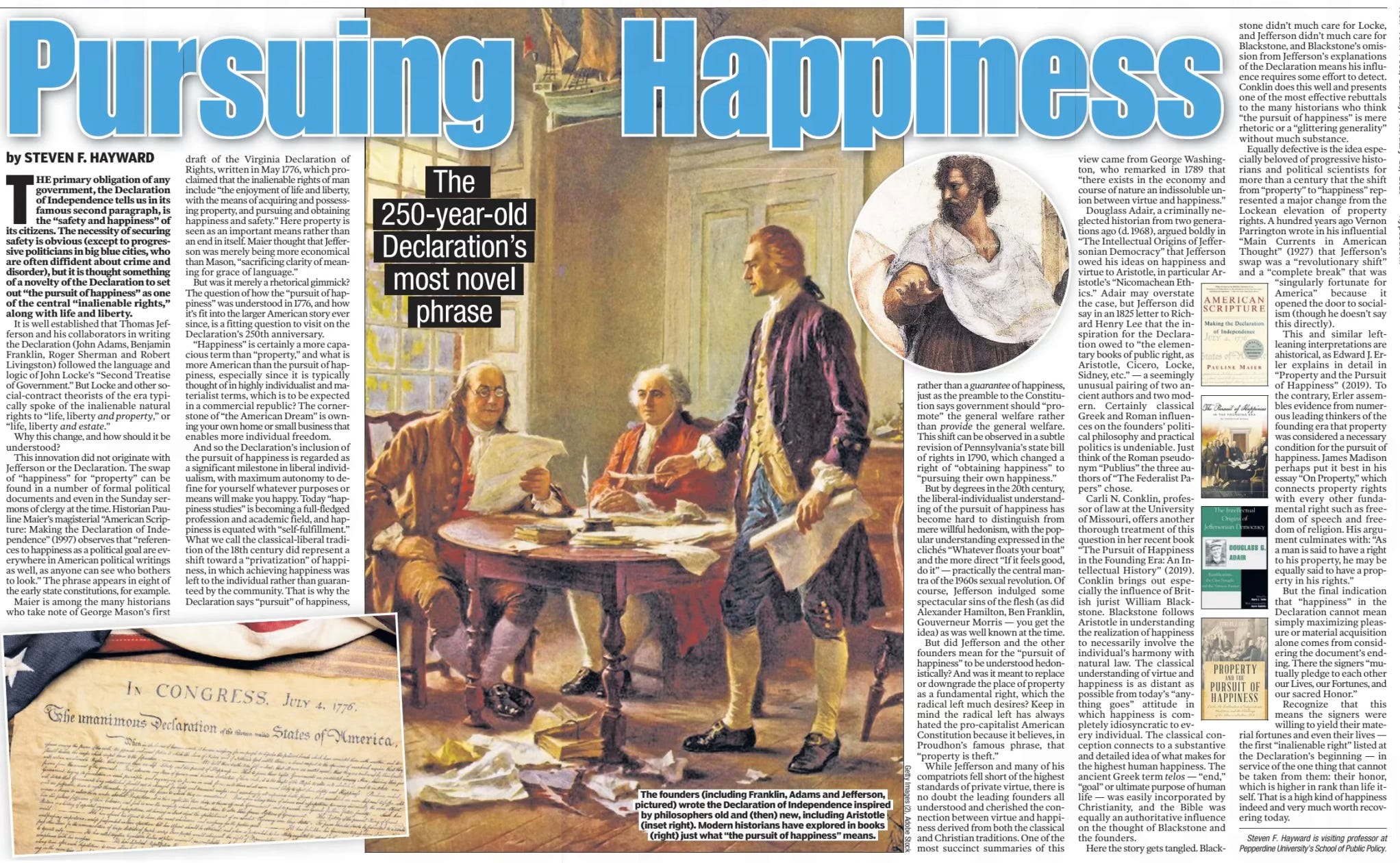
• Finally, yours truly is back in the Sunday “Postscript” section of the New York Post with another feature installment about the 250th anniversary of the Declaration of Independence, this time focusing on the origin and meaning of the pregnant phrase “pursuit of happiness.” The article is still not out from the semi-paywall, but might be accessed for the time being here. (I’ll update this once it comes out fully from behind the paywall or ‘Press Reader’ portal.) Excerpt:
But by degrees in the 20th century, the liberal-individualist understanding of the pursuit of happiness has become hard to distinguish from mere willful hedonism, with the popular understanding expressed in the clichés “Whatever floats your boat” and the more direct “If it feels good, do it” — practically the central mantra of the 1960s sexual revolution. Of course, Jefferson indulged some spectacular sins of the flesh (as did Alexander Hamilton, Ben Franklin, Gouverneur Morris — you get the idea) as was well known at the time.
But did Jefferson and the other founders mean for the “pursuit of happiness” to be understood hedonistically?
From here I answer at length why the answer to this question is No—that in fact the classical understanding of happiness as a product of virtue—teleologically understood—was front and center for the founders, before concluding thus:
But the final indication that “happiness” in the Declaration cannot mean simply maximizing pleasure or material acquisition alone comes from considering the document’s ending. There the signers “mutually pledge to each other our Lives, our Fortunes, and our sacred Honor.”
Recognize that this means the signers were willing to yield their material fortunes and even their lives — the first “inalienable right” listed at the Declaration’s beginning — in service of the one thing that cannot be taken from them: their honor, which is higher in rank than life itself. That is a high kind of happiness indeed and very much worth recovering today.
The double-truck spread in the Post.
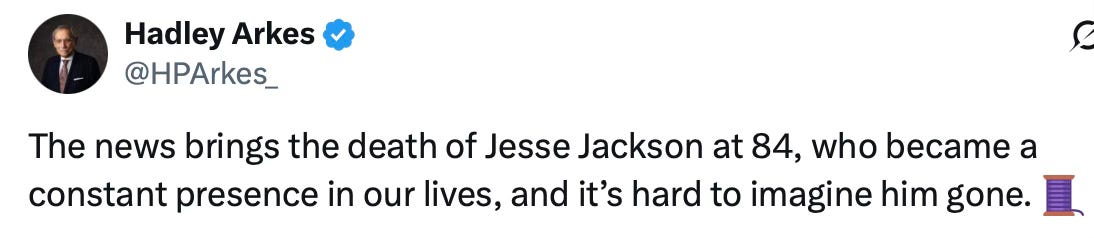
• Our pal and occasional contributor Hadley Arkes also takes note of the passing of Jesse Jackson, and relates a story of a debate he once had with the good Rev:
He was a huckster, and as our friends at the Wall Street Journal put it, a shakedown artist, drawing business for his projects as he called forth scorn on corporations for their racism, and then decorously receded from the charges as soon as “arrangements” were settled.
And yet there was a vibrancy about Jesse, which could draw anyone who came into his presence. We had an interesting set-to, a debate on Capital Punishment in New York, in April 1997, which is still shown on C-SPAN. I have a hunch that they may bring it back now.
Hadley versus Jesse
It was a battle between a conservative and liberal magazine—National Review v. The Nation. I took the lead for my side, joined by the formidable Steve Markman, just before he was appointed to the Supreme Court of Michigan. Jesse was joined by Christopher Hitchens, always nimble and sharp-tongued (and who became later a friend). The moderator was Ed Koch, the former mayor of New York.
Hadley, second from the right.
I opened by recalling Laurence Olivier’s story of Marilyn Monroe, complaining of the cuisine served up by Arthur Miller’s mother. After the third meal in a row with matzah balls, she said, “Don’t they ever eat any other part of the matzah?!” As the laughs came in, I took that as my “high hard one” to Jesse after his famous remarks about New York as “Hymietown.” And the message was: We’re in New York, you’re on my turf, I can get laughs here.
The one who was never laughing during the debate was the remarkable actor Paul Newman, who was one of the bankrollers of the liberal Nation magazine. As it became clear, from the reactions of the audience, that our side was gaining the upper hand in the debate, Newman’s scowl deepened. Ed Koch, in a column he wrote the next week, said that, even though he was the moderator, he had to say that Arkes and Markman won the debate. Well, we can invite people to view that debate yet again and make up their own minds.
But after we finished the debate, Jesse came over and gave me a very warm hug. My friend Werner Dannhauser, at Cornell, took that as a mark against me. But the hug showed the joyousness that Jesse could bring to these outings, even for people on the other side.
Jesse had been, in the 1970’s, a strong pro-life voice, quite concerned for what abortion was doing to his own community of black people in this country. He put aside and then silenced his pro-life arguments as he started taking hold, as a serious contender in the Democratic primaries for President.
I long held to the hope that, if I ever get him back in conversation, that I might draw him back to the concerns he once expressed with such earnest conviction. For the truths he recognized then are still true. Well, another thing that slipped past in this life, and I count that as work left undone.
Jesse lit up things around him; may he rest in peace.
It's nice to see the new CA newspaper get off on the right foot by asking Lucretia coming out from her nom de plume to comment on Chuck Shumer's ICE- mongering. She writes well, even for an academic.
I've been studying the British system of government for a few years now. It's difficult for a foreigner to understand, as many hidden assumptions are seldom written down. I ended up purchasing a UK high school civics textbook which explains their system at length.
Simply put, the British have no concept of the separation of powers. Parliament is their legislative branch, but their executive branch, the PM and his cabinet, is merely a panel of members of Parliament. This is expressly forbidden in the US. US Constitution Art. I section 6 paragraph 2.
The British judicial branch is a panel of law lords in the House of Lords. If the US followed this example, our SCOTUS would be the members of the Senate judiciary committee. We could have had Teddy Kennedy interpreting Constitutional law for us.
The Articles of Confederation was only in force for eight years, but that amount of time was enough to show the weakness of a government with no executive branch.






It's nice to see the new CA newspaper get off on the right foot by asking Lucretia coming out from her nom de plume to comment on Chuck Shumer's ICE- mongering. She writes well, even for an academic.
I've been studying the British system of government for a few years now. It's difficult for a foreigner to understand, as many hidden assumptions are seldom written down. I ended up purchasing a UK high school civics textbook which explains their system at length.
Simply put, the British have no concept of the separation of powers. Parliament is their legislative branch, but their executive branch, the PM and his cabinet, is merely a panel of members of Parliament. This is expressly forbidden in the US. US Constitution Art. I section 6 paragraph 2.
The British judicial branch is a panel of law lords in the House of Lords. If the US followed this example, our SCOTUS would be the members of the Senate judiciary committee. We could have had Teddy Kennedy interpreting Constitutional law for us.
The Articles of Confederation was only in force for eight years, but that amount of time was enough to show the weakness of a government with no executive branch.