
Jesse Jackson, RIP
Revisiting Hymietown, and the turbocharging of today's identity politics


The Rev. Jessie Jackson, who passed away at 84 on Monday, was a “towering civil rights icon who battled alongside Martin Luther King Jr., negotiated global hostage releases, and shamed corporations for their lack of corporate diversity and failure to support voting rights.” And so on, but there’s more about him people should recall.
Here’s a thing to understand about the legacy of Jackson: his radical views and his “rainbow coalition” presaged the arrival of the full-blown identity politics that have so badly deranged American politics and culture over the last generation. It is not clear whether his “rainbow coalition” directly inspired the now ubiquitous rainbow flag, but he certainly advanced the ideology.
He first unveiled his “rainbow coalition” gimmick in the 1984 Democratic campaign. One of us (Steve) was present in the San Francisco convention hall in 1984 as a reporter (the first and only national convention I ever attended) for his prime-time speech, and it was indeed electrifying inside the hall. Reading the text in the newspaper the next day. . . not so much. The orator was greater than the oratory.
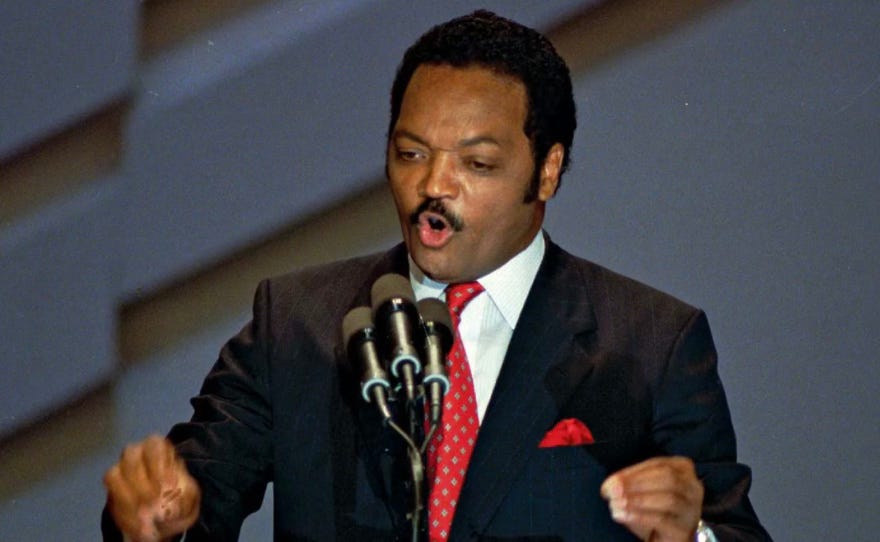
Steve wrote this in his dispatch from the convention:
Consider his introduction to the convention as an example of his approach. In keeping with his rainbow coalition motif, he was introduced by nine people: an Arab-American, a blind black student from South Carolina, a Jewish holocaust survivor, an Hispanic from Texas, a Chinese-American woman, a farmer, an African Methodist bishop, a disabled-Hispanic-single-welfare mother from New Mexico (“If I went to work I’d lose my medical benefits…”), and, finally, mercifully, Mayor Richard Hatcher of Gary, Indiana.
All this build-up took almost forty minutes, during which time you couldn’t help but reflect: James Watt lost his job for talking this way about different groups of supposed victims and “diversity.” Now Jackson is parading it in front of us.
Now, you can spot the outlier in his nine of introducers: the Jewish holocaust survivor. Such a person would not be featured by Democrats today. But Jackson had to do it to make up for a campaign blunder.
During a conversation with Washington Post reporter Milton Coleman during the 1984 primary campaign, Jackson referred to Jews as “Hymies,” and New York City as “Hymietown.” That caught the attention of Eddie Murphy, who worked up a “Hymietown” song for the February 2, 1984 Saturday Night Live.
The Rev. Jackson apologized for “Hymietown” but refused to denounce Louis Farrakhan. The Nation of Islam leader threatened Coleman and warned Jews that “if you harm this brother, I warn you in the name of Allah, it will be the last one you harm.” So it took guts for Eddie to step up and sing.
But the point is, Jackson was in retrospect a key moment in the long chain of normalizing anti-Semitism in the Democratic Party.
It is not widely recalled now that after his strong showing in southern primaries in 1984, Jackson was a credible contender for the Democratic nomination in 1988. In fact after he swept the “super Tuesday” primaries in March, the Democratic establishment panicked, realizing that after losing 49 states to Ronald Reagan in 1984, they’d lose all 50 states in 1988 if Jackson was the nominee. Jackson won 11 primaries, gaining 1,218 delegates (the second highest) with 7 million votes—almost as many as Walter Mondale had won in his successful nomination run in 1984.
Just as the Democratic establishment panicked in 2020 when they realized Bernie Sanders might capture the nomination and decided to coalesce around Sleepy Senile Joe, in 1988 the Democratic establishment embarked on a “Stop-Jackson” campaign and rallied around the implausible but somehow decently performing Michael Dukakis. Jackson came to the convention with his 1,218 delegates, a strong second place, thinking he was entitled to the vice presidential nomination, but Dukakis brushed him off and went with the supposedly “conservative” Lloyd Bentsen of Texas in a traditional ticket-balancing exercise.
The plain trouble with Jackson was that he was way too far left even for a party that was galloping leftward at a rapid pace already. But winning elections since the 1980s has required Democrats to conceal this fact, while Jackson proclaimed the party’s leftism from a bullhorn. Even leftist pollster Stanley Greenberg said in 1988 that Jackson was “right message, wrong messenger,” and that middle class white Democrats “could never see themselves voting for Jesse Jackson.”
Jackson wasn’t always a far-leftist in his political views. In the early 1970s he opposed abortion on demand, and he used to embrace a platform of black self-help. He would tell young black students that they could be just as good math as they are at basketball if they put in the same amount of time studying as they did playing hoops on the hardcourt. But eventually the lucrative lure of victimization overcame his good sense.
One person who understood what a millstone Jackson was for Democrats was Arkansas Gov. Bill Clinton. In 1990 Clinton told Scripps-Howard reporter Peter Brown: “’I have never believed Democrats need to distance themselves from [Jackson]. I think the Democrats need to disagree with him. A lot of traditional white liberals get uptight and pull back, but they don’t ever explicitly disagree with Jackson,’ because they worry their ideological differences will be taken as a racial slight.”
Cue Clinton’s famous “Sister Souljah” moment two years later.
Peter Brown noted how the mainstream media were practically partners in the Jackson campaign, as they were 20 years later for Obama:
Jackson also benefitted greatly from this double-standard. Perhaps because the media didn’t think he could win, perhaps because they bent over backwards to avoid charges of racism, they treated Jackson (and his ideas) more gingerly than they did the other candidates. In fact, a study by the Center for Media and Public Affairs found that 75 percent of the network coverage of Jackson during the campaign had been positive, 20 points higher than for any of the other candidates.
This, too, is a fact now evident to more and more Americans
But perhaps the best way to recall him at the hour of his passing is noting that comedians had a more accurate take on Jackson, and Democrats in general, than the mainstream media did. And amazing as it is to behold, Saturday Night Live did the job the media refused to do.
As Carly Simon might say, nobody does Jesse Jackson better that Eddie Murphy, and check out “White Like Me,” for Murphy’s take on racial disparities. Those were the days when SNL took on all comers, as in “Dukakis After Dark,” from November 5, 1988. Michael Dukakis (John Lovitz) concedes that Democrats “represent unpopular and discredited views,” and “one thing that hurt us is the fact that Reaganomics works. It really does.” He tells Jimmy Carter (Dana Carvey) “I’m about to lose as bad as you did. Maybe worse. How did you deal with it afterwards?”
“I was one pissed-off cracker,” Carter says. “I had to accept the fact that I was a downer. A liberal downer. A malaise-ridden liberal downer. A free-spending malaise-ridden liberal downer, who only knew. . .”
The skit also features Ted Kennedy (Phil Hartman) hitting on Kitty Dukakis (Jan Hooks), Leroy Nieman (Kevin Nealon) painting a picture of the aircraft carrier Nimitz converted to a homeless shelter, and Joan Baez (Nora Dunn) singing:
Unilateral lateral disarmament, abortions on demand
Take everybody’s guns away, and toss them in the sand.
Free needles for the addicts, free condoms for the kids
We’ll not blame the criminal for anything he did.
For who can say what’s right or wrong, is there such a thing as sin?
It doesn’t really matter really matters, if wars we lose or win.
Those were the days.
Chaser—this is going to drive some liberals out of their minds:
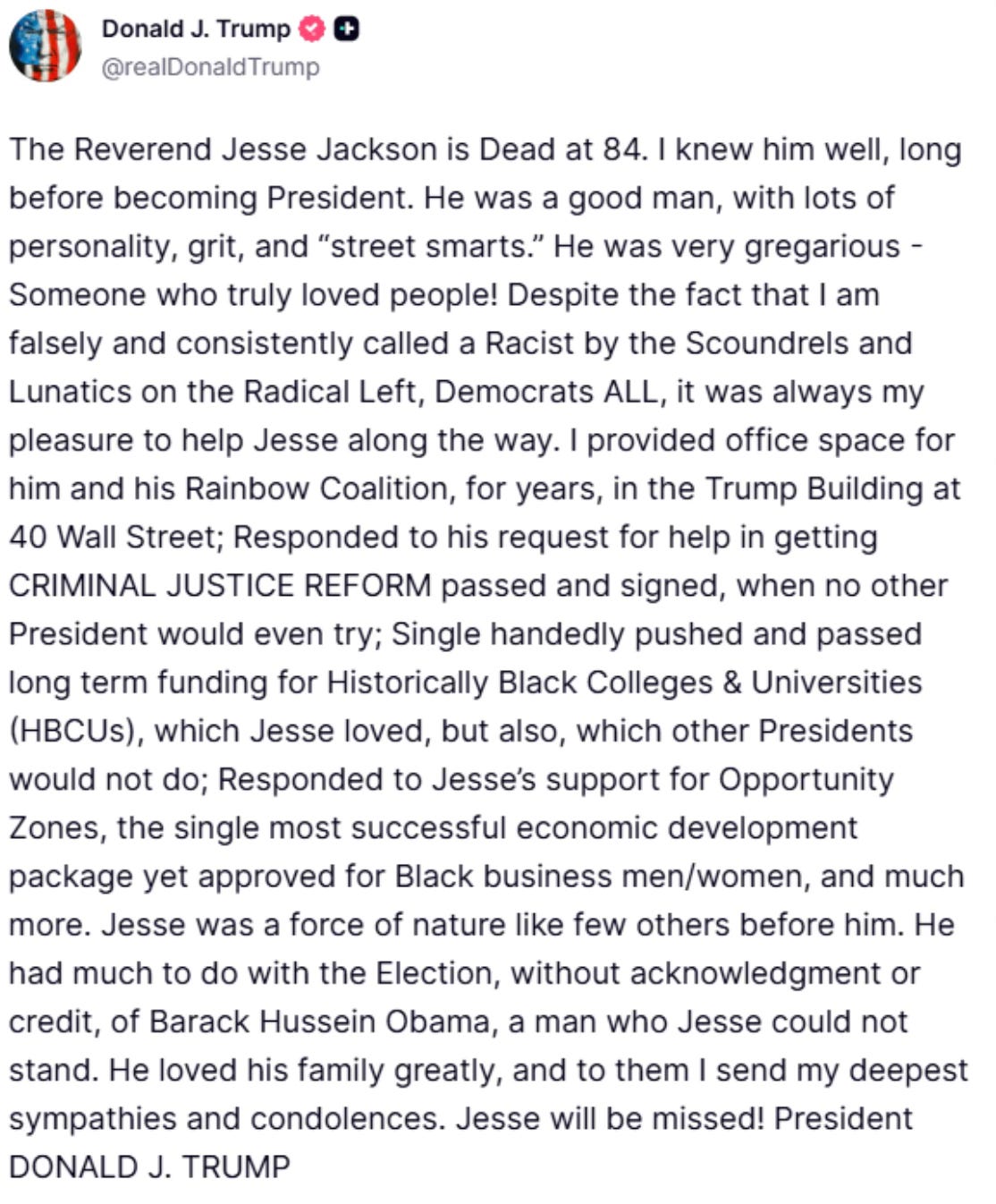
 | A guest post by
|
Perhaps nothing better highlights today's Democratic party's all-encompassing malignancy than the fact that Jesse Jackson -- a venal race-hustler and civil rights fraud -- now seems a respectable grifter and middling anti-Semite compared with the pathological, race-hating jackals who occupy pride of place and power in the D's wretched hive of lionized scum and villainy.
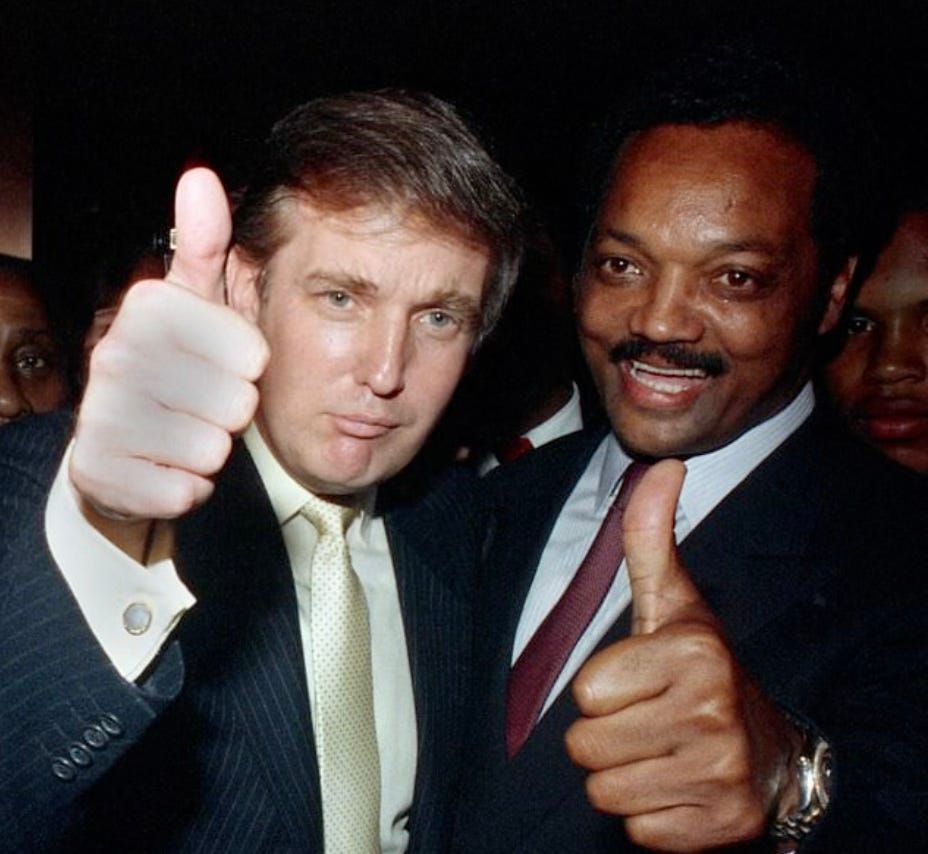
The closing photo reminds us that no one knew Mr. Trump was a racist until he ran for the Republican nomination.