
Gordon Wood, RIP
Last of the old-school American historians

The news that Gordon Wood has died in a ghastly accident—struck down by a driver in a shopping mall parking lot—hits hard less than a month before the 250th anniversary celebration of the Declaration of Independence. I hope it isn’t an ill omen of some kind.
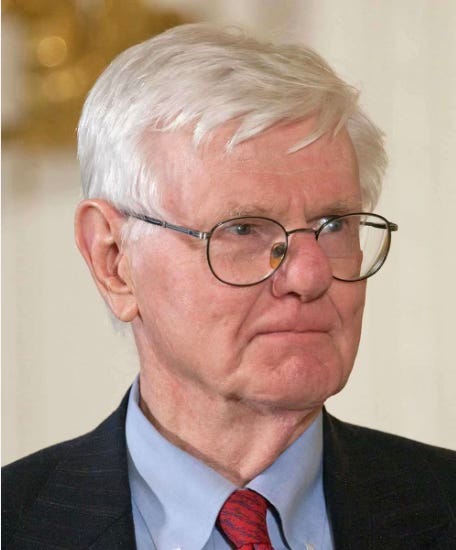
I’ll have an obit piece coming our shortly at Civitas Outlook in which I note that he has in recent years—and especially this year in the runup to the semiquincentennial—been justly enjoying a burst of attention for his body of work on the American Revolution. The piece will note his evolution over his long career toward a more balanced and sound view of the Founding, and how he had moved to the right in many ways. Last fall I was present to hear him deliver the annual Irving Kristol Lecture in Washington, where he confessed embarrassment at having voted for Adlai Stevenson back in his student days, asking rhetorically "What was I thinking?," and confessing that today he can be regarded as "one of those liberals mugged by reality." He stepped up and joined the group of leading academic historians in attacking the egregious 1619 Project, saying “We all want justice, but not at the expense of truth," adding that “I don’t know of any colonist who said that they wanted independence in order to preserve their slaves." (I’ll update this with a link when it goes live.)
Here I will simply note that I had been very hard on Wood in a long piece I wrote for the Claremont Review of Books 20 years ago because of the way in which his most famous work, The Creation of the American Republican, 1776-1787, had been adopted by the left as a weapon to attack the American Founding and our constitutional order. And I noted right here on Political Questions several months ago how John Patrick Diggins, a liberal himself, had made one of the most substantial criticisms of Wood back in the 1980s:
Diggins sounds more like a political philosopher than a historian with zingers like this:
“If one were to follow to its logical conclusion Wood’s advice, intellectual history would become not the history of ideas but of opinions and interpretations, and the historian would have no way of judging the accuracy or rightfulness of such opinions and interpretations.”
Or, “Evidence of Lockean liberalism seems to be everywhere in American history and nowhere in American historiography.”
Diggins really warmed up to this theme in On Hallowed Ground:
“But it has been fashionable lately in historiography to use the term ‘republicanism’ with all the implications for ‘public virtue’ and ‘civic humanism.’ Such expressions caught on in scholarship as an effort to prove that the liberalism articulated by the older school can now be challenged and that the consensus scholars missed seeing that American history had had a non-capitalist alternative somewhere in the past.“
Or more succinctly:
“It is curious that historians have joined together republicanism and Marxism in order to offer a challenge to consensual liberalism and capitalism.”
But by degrees Wood changed or added to his interpretation of the Founding, at length celebrating the centrality of the Declaration of Independence in Lincolnian terms. (The Declaration was nearly absent in his Creation of the American Republic.)
Beyond that story arc, Wood can be seen as perhaps the last of the great Americanist historians in the mold of Bernard Bailyn, Oscar Handlin, or Daniel Boorstin. The mediocre and unjustly celebrated academics who attempt to write about the American Founding today—I’ll skip over the main suspects for the moment—aren’t worthy of comparison to Wood.
On top of everything else, Wood was a genial person, impossible to dislike.
Let’s get out with how he even entered the world of pop culture, with this (inaccurate) reference to his work in the Matt Damon-Ben Affleck breakout film Good Will Hunting in 1997:
Dear Sir, I am going to go off topic here. Can you recommend a good history of the founding of the US 1750-End of revolution approximately. And a good biography of Washington. Length is not a problem I read very quickly, and I have time. Sorry for the gall? cant think of good word. I also read your columns every week. They are fascinating.
RIP. So sad he won't be here for the USA's 250th birthday. Something he would have celebrated, no doubt.