
Final Weekend Reflections
On Charlie Kirk, goofy leftists, and other matters on our mind

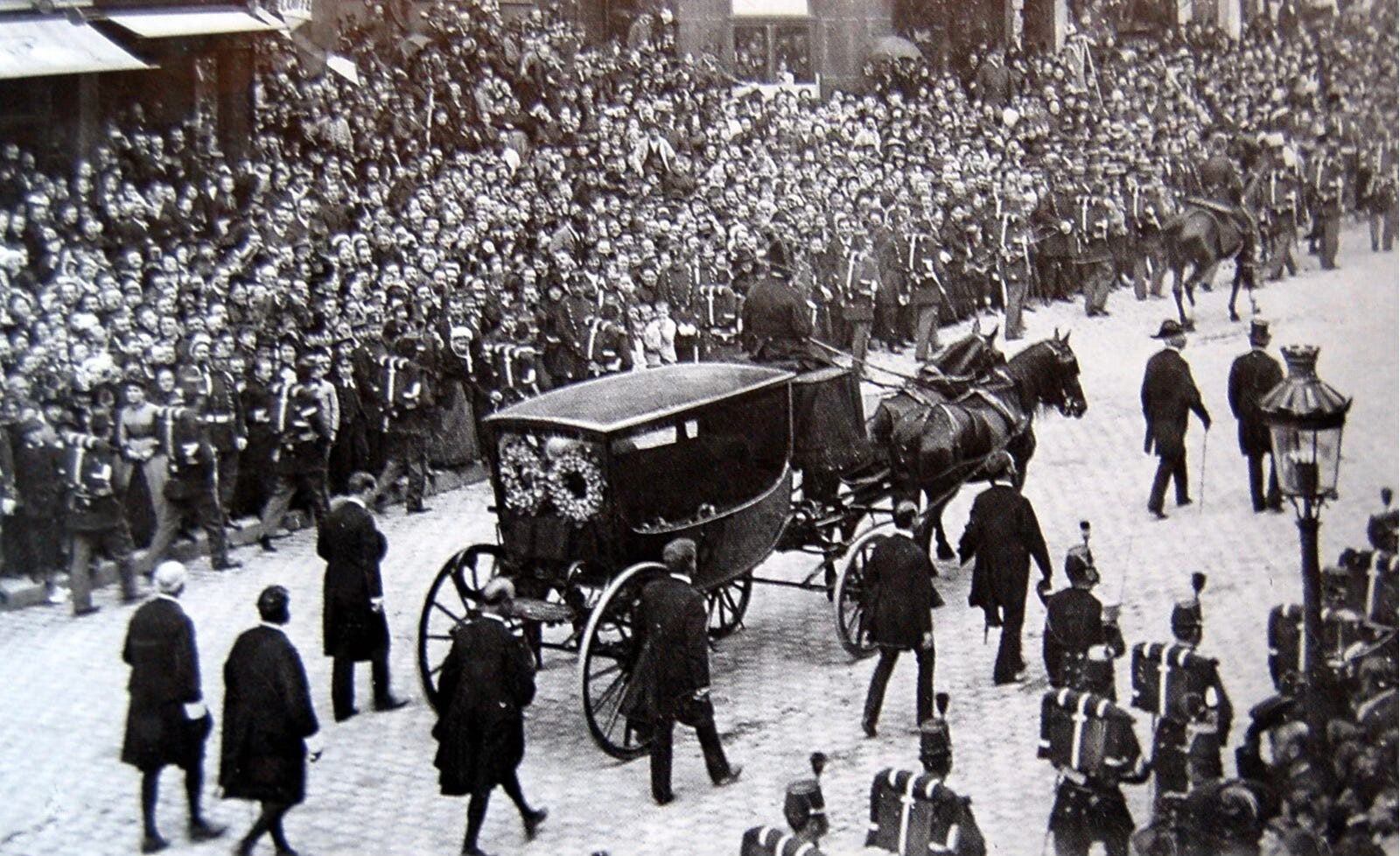
• All of Paris—maybe three million people—turned out for the funeral procession of Victor Hugo after his death in 1885, so much did he mean to the French. Watching Charlie Kirk’s memorial service, and knowing millions are watching the broadcast, has a similar character. Not even the passing of Rush Limbaugh elicited such an outpouring of collective grief and deep meaning.
• What is it about socialism (or leftism in general perhaps) that attracts nuts and nuttiness?
I imagine most readers have heard George Orwell’s famous quip about this:
“One sometimes gets the impression that the mere words ‘Socialism’ and ‘Communism’ draw towards them with magnetic force every fruit-juice drinker, nudist, sandal-wearer, sex-maniac, Quaker, ‘Nature Cure’ quack, pacifist, and feminist in England.”
But lately I ran across a similar observation from Ernst Toller, a pre-war German poet and playwright who was involved in radical politics in Munich right after World War I (never mind why I’m delving into Toller at the moment—a separate article involving Toller is on the way). Toller had a senior position in a short-lived “Soviet republic” established in Munich (which the local Communist Party opposed because they didn’t control it outright—go figure), and you’ll never guess what happened next. From Toller’s autobiography, I Was a German:
“Unappreciated cranks submitted their programs for the betterment of humanity, believing that at last their much-scorned ideas would have a chance to turn earth into Paradise. They all had their own infallible and omnipotent cures; and, granted their premises, their logic was unimpeachable. Some believed that the root of all evil was cooked food, others the gold standard, others unhygienic underwear, or machinery, or the lack of compulsory universal language, or multiple stores, or birth control. They reminded me of the Swabian shoemaker who wrote a voluminous pamphlet to prove that man owed his moral sickness to the fact that he satisfied his elementary needs in closed rooms and with the aid of artificial paper; whereas if he spent these daily moments out in the woods and availed himself of the natural moss all spiritual poisons would evaporate into the surrounding air.”
This last idea sounds like any number of cults in California.
• Separately I’ve been delving into Max Weber lately for a particular project, and along with it Leo Strauss’s devastating critique of Weber in Natural Right and History. In particular, Strauss clobbers the tendency of social scientists averse to “value judgments” to place quotation marks around terms that involve any kind of moral judgment:
“To put the terms designating such things in quotation marks is a childish trick which enables one to talk of important subjects while denying the principles without which there cannot be important subjects—a trick which is meant to allow one to combine the advantages of common sense with the denial of common sense.”
Nicely put, though I note one exception: in much academic social science today, the term “racist” (and its close relation “white supremacy”) is usually not placed in quotation marks, because for the left is it considered an indisputable fact always.
All I have to say is buy Steve’s book about M Stanton Evans. I have not finished it but thus far it is terrific. Great life story , great wisdom and a lot of laughs.
When you stop believing in God it doesn't mean you believe in nothing; it means you will believe anything. h/t Chesterton, of course.