
Fatal Mis-Conception
The definitive treatment of Ehrlichism

The passing of Paul Ehrlich, noted here Sunday evening, seems to have considerable legs, which perhaps should not be surprising given his huge celebrity decades ago, but I already considered him a has-been when I encountered him in person 20 years ago. A few commenters mentioned the famous bet with Julian Simon. Ehrlich had written that "If I were a gambler, I would take even money that England will not exist in the year 2000."
Now let us pause here and say this might be one place where Ehrlich was indeed premature, and partly because of his own busted hypothesis. England may not exist that much longer, precisely because of the population growth of a certain portion of its current population—the segment whose high fertility rate has brought us to the point where the most popular and most numerous name for newborns in Britain is Mohammed.
In any case, the great economist Julian Simon, who I got to know quite well before his untimely passing in 1998, in 1980 pitched a $1,000 bet to Ehrlich and his occasional fellow Malthusian co-author (and later Obama science adviser) John Holdren, in which Ehrlich and Holdren could pick five resources, with Simon contending their inflation-adjusted prices would be lower a decade later. Ehrlich picked copper, chromium, nickel, tin, and tungsten. Simon won on all five, and Ehrlich paid up in inflation-adjusted dollars for the changes in prices of each commodity (under the peculiar terms of the bet). Julian shared a pic of the check with a lot of us—the ultimate receipt:

But arguably the greatest takedown of Ehrlich came from a liberal Columbia University historian, Michael Connelly, whose 2008 book Fatal Misconception: The Struggle to Control World Population offered a bracing critique of the global population control movement that was already underway at the time of Ehrlich’s bomb of a book, though Ehrlich helped propel it into overdrive.
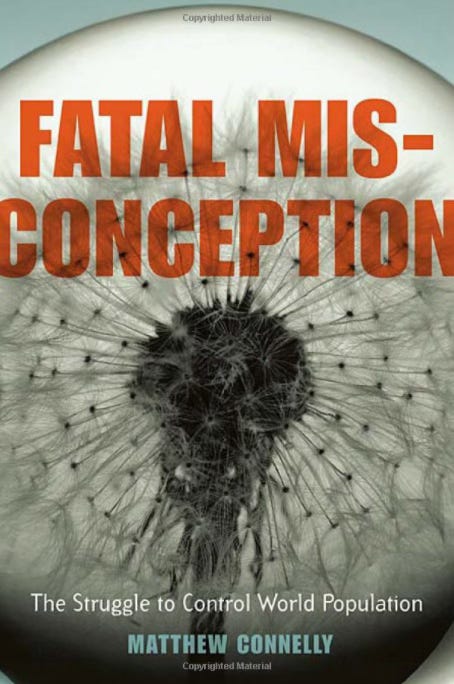
It’s a capacious history starting in the early decades of the 20th century. Connelly recounts one of the first major international conferences on world population, held in Geneva in 1927, where Albert Thomas, a French trade unionist, asked, “Has the moment yet arrived for considering the possibility of establishing some sort of supreme supranational authority which would regulate the distribution of population on rational and impartial lines, by controlling and directing migration movements and deciding on the opening-up or closing of countries to particular streams of immigration?” Connelly also describes the 1974 World Population Conference, which “witnessed an epic battle between starkly different versions of history and the future: one premised on the preservation of order, if necessary by radical new forms of global governance; the other inspired by the pursuit of justice, beginning with unfettered sovereignty for newly independent nations.” (Emphasis added.) Notice that whatever the problem might be, whether population, climate, or trade, the answer from the left is always the same: global government.
The Intergovernmental Panel on Climate Change (IPCC), the U.N.-sponsored body that is the juggernaut of today’s climate campaign, finds its precedent in the International Union for the Scientific Investigation of Population Problems (IUSIPP), spawned at the 1927 World Population Conference. A bevy of NGOs, most prominently the International Planned Parenthood Federation (IPPF) and Zero Population Growth (ZPG), later sprang into being, working hand-in-glove with the same private foundations (especially Ford and Rockefeller) and global financial institutions, such as the World Bank, that today are in the forefront of the climate campaign.
As Connelly lays out in painstaking detail, population control programs, aimed chiefly at developing nations, proliferated despite clear human rights abuses and, more importantly, new data and information that called into question many of the fundamental assumptions of the crisis mongers. Connelly recalls computer projections and economic models that offered precise and “scientifically grounded” projections of future global ruin from population growth, all of which were quickly falsified. The mass famines and food riots that were predicted never occurred; fertility rates began to fall everywhere, even in nations that lacked “family planning” programs.
The coercive nature of the population control programs in the field was appalling. India, in particular, became “a vast laboratory for the ultimate population control campaign,” the chilling practices of which Connelly recounts:
Sterilizations were performed on 80-year-old men, uncomprehending subjects with mental problems, and others who died from untreated complications. There was no incentive to follow up patients. The Planning Commission found that the quality of postoperative care was “the weakest link.” In Maharashtra, 52 percent of men complained of pain, and 16 percent had sepsis or unhealed wounds. Over 40 percent were unable to see a doctor. Almost 58 percent of women surveyed experienced pain after IUD insertion, 24 percent severe pain, and 43 percent had severe and excessive bleeding. Considering that iron deficiency was endemic in India, one can only imagine the toll the IUD program took on the health of Indian women.
These events Connelly describes took place in 1967, but instead of backing off, the Indian government—under constant pressure and lavish financial backing from the international population control organizations—intensified these coercive programs in the 1970s. Among other measures India required that families with three or more children had to be sterilized to be eligible for new housing (which the government, not the private market, controlled). “This war against the poor also swept across the countryside,” Connelly notes:
In one case, the village of Uttawar in Haryana was surrounded by police, hundreds were taken into custody, and every eligible male was sterilized. Hearing what had happened, thousands gathered to defend another village named Pipli. Four were killed when police fired upon the crowd. Protesters gave up only when, according to one report, a senior government official threatened aerial bombardment. The director of family planning in Maharashtra, D.N. Pai, considered it a problem of “people pollution” and defended the government: “If some excesses appear, don’t blame me…. You must consider it something like a war. There could be a certain amount of misfiring out of enthusiasm. There has been pressure to show results. Whether you like it or not, there will be a few dead people.”
In all, over 8 million sterilizations, many of them forced, were conducted in India in 1976—”draconian population control,” Connelly writes, “practiced on an unprecedented scale…. There is no way to count the number who were being hauled away to sterilization camps against their will.” Nearly 2,000 died from botched surgical procedures. The people of India finally put the brakes on this coercive utopianism, at the ballot box: the Congress Party, which had championed the family planning program as one of its main policies, was swept from office in a landslide, losing 141 of 142 contested seats in the areas with the highest rate of sterilizations. At least the people of India had recourse to the ballot box; the new environmental constitutionalism will surely aim to eliminate this remedy.
One reason why enthusiasms and programs maintain their forward momentum in the face of changing facts and circumstances is the culture of corruption that inevitably comes to envelope self-selecting leadership groups organized around a crisis. Connelly ably captures this seamy side of the story:
Divided from within and besieged from without, leaders created a “system without a brain,” setting in motion agencies and processes that could not be stopped. The idea of a “population crisis” provided the catalyst. But this was a system that ran on money. Earmarked appropriations greased the wheels of balky bureaucracies, and lavish funding was the fuel that drove it forward. But so much poured in so fast that spending became an end unto itself. The pressure to scale up and show results transformed organizations ostensibly dedicated to helping people plan their families into tools for social engineering…. Rather than accept constraints or accountability, they preferred to let population control go out of control.
Corruption extended on a personal level to the New Class directing these world-saving crusades, what Connelly calls “the new jet set of population experts.”
The lifestyle of the leaders of the population control establishment reflected the power of an idea whose time had come as well as the influence of the institutions that were now backing it…. Alan Guttmacher was in the habit of beginning letters to the Planned Parenthood membership with comments like “This is written 31,000 feet aloft as I fly from Rio to New York.” He insisted on traveling with his wife, first class, with the IPPF picking up the tab. Ford [Foundation] officials flew first class with their spouses as a matter of policy. One wonders why Douglas Ensminger [the Ford Foundation’s India officer] ever left his residence in Dehli—he was served by a household staff of nine, including maids, cooks, gardeners, and chauffeurs. He titled this part of his oral history “The ‘Little People’ of India.” Ensminger insisted on the need to pay top dollar and provide a plush lifestyle to attract the best talent, even if the consultants he recruited seemed preoccupied with their perks. One of these strivers ran his two-year old American sedan without oil just so that the Ford Foundation would have to replace it with the latest model….
For population experts this was the beginning of constantly expanding opportunities. The budgets, the staff, the access were all increasing even more quickly than the population growth their programs were meant to stop. There was “something in it for everyone,” Population Association of America President John Kantner later recalled: “the activist, the scholar, the foundation officer, the globe-circling consultant, the wait-listed government official. World Conferences, a Population Year, commissions, select committees, new centers for research and training, a growing supply of experts, pronouncements by world leaders, and, most of all, money—lots of it.”
Sounds rather like the moveable feast that is the IPCC’s annual meetings, often held in hardship locales such as Bali, to press ahead with anti-global warming efforts. The magnitude of the traveling circus of the climate campaign has come to dwarf the population crusade. Prior to the arrival of climate change as a crisis issue, the largest single U.S. government science research project was the acid rain study of the 1980s (the National Acid Precipitation Assessment Project, or NAPAP for short), which cost about $500 million, and concluded that the acid rain problem had been vastly overestimated. (Public opinion polls in the late 1970s rated acid rain the most significant environmental problem of the time.) Today the U.S. government is spending multiple billions each year on climate research—so much through so many different agencies and budget sources that it is impossible to estimate the total reliably.
With so much money at stake, and with so many careers staked to the catastrophic climate scenario, one could predict that the entire apparatus would be resistant to new information and reasonable criticism. This is exactly what happened in the population crusade. When compelling critics of the population bomb thesis arose—people who might be called “skeptics,” such as Julian Simon—the population campaign reacted by circling the wagons and demonizing its critics, just as global warming skeptics today are subjected to relentless ad hominem attacks. Connelly again:
Leaders of the population control movement responded…by defending their record and fighting back. They lined up heads of state, major corporations, and international organizations behind a global strategy to slow population growth. But they also worked more quietly to insulate their projects from political opposition by co-opting or marginalizing critics, strengthening transnational networks, and establishing more free-standing institutions exempt from normal government oversight.
The United Nations, in the early 1990s, officially downgraded the priority of population growth as a pressing global issue, because climate change became a new and better issue for promoting global governance.
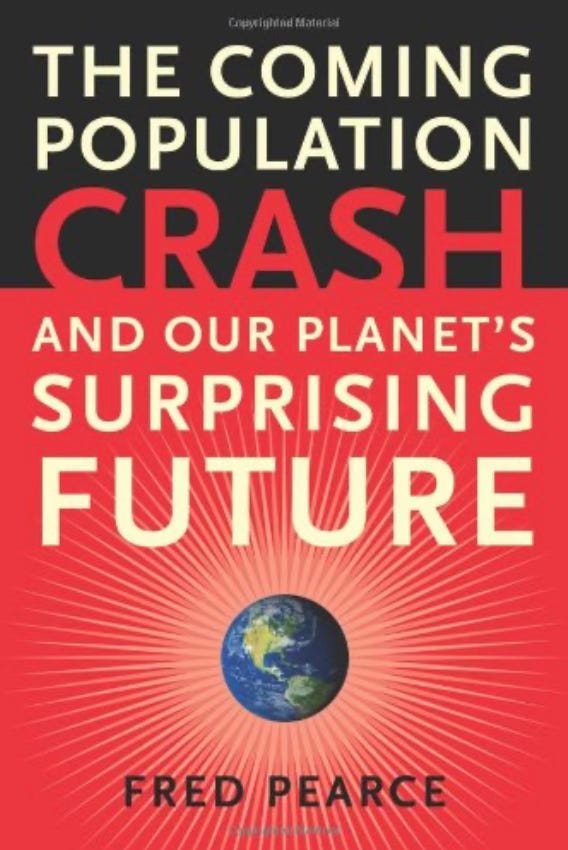
A couple years after Connelly the British environmental writer Fred Pearce published The Coming Population Crash and Our Planet’s Surprising Future. Pearce followed Simon in holding an optimistic view of the planet’s future, and was scornful of the coercive and authoritarian measures the population control movement promoted. Worth having on your reading list if you want to delve into this subject further.
Acting on the advice of 'experts' has been the bane of human progress for several millenia.
And an interesting footnote: why did Ehrlich's wife sign the check to Simon?
Great stuff! interesting and timely.
When I first read Connelly's fetal misconception (i know, I can't spell) I had the odd thought that his next book should be on the homeless industry..
I thought then, and think now, that one reason this stuff sold so well to the academic and political elites is that they can afford travel - because nothing convinces anyone of the need for population control faster than a day in Delhi, Taipei, or (now) London - but don't have a gut understanding of of geography because it's all fly-over country to them. So they see and fear noisy, sweaty, stinking crowds, but have no experience of wide open spaces.