
Can Europe Save Itself?
About that National Security Strategy report released last week

From the media coverage of the new National Security Strategy that the Trump Administration released last week, you’d think the United States was giving the middle finger to Europe and casting the continent adrift after decades of strategic partnership through NATO. Time magazine, which apparently still exists, calls it a “far-right pamphlet.” The New York Times complains that “Trump’s Security Strategy Focuses on Profit, Not Spreading Democracy.” I’m so old I can remember when the Times was alarmed and dismayed when Ronald Reagan made spreading democracy a key part of his foreign policy starting in 1982.
It pays to read the document itself, which is only 30 pages long. Here is the key part about Europe that has everyone’s heavily-tariffed knickers in a bunch, in a section cheekily called “Promoting European Greatness”:
American officials have become used to thinking about European problems in terms of insufficient military spending and economic stagnation. There is truth to this, but Europe’s real problems are even deeper.
Continental Europe has been losing share of global GDP—down from 25 percent in 1990 to 14 percent today—partly owing to national and transnational regulations that undermine creativity and industriousness.
But this economic decline is eclipsed by the real and more stark prospect of civilizational erasure. The larger issues facing Europe include activities of the European Union and other transnational bodies that undermine political liberty and sovereignty, migration policies that are transforming the continent and creating strife, censorship of free speech and suppression of political opposition, cratering birthrates, and loss of national identities and self-confidence.
Should present trends continue, the continent will be unrecognizable in 20 years or less. As such, it is far from obvious whether certain European countries will have economies and militaries strong enough to remain reliable allies. Many of these nations are currently doubling down on their present path. We want Europe to remain European, to regain its civilizational self-confidence, and to abandon its failed focus on regulatory suffocation.
Pass the popcorn. Europeans like to complain that America is not interested in providing the kind of vigorous leadership to the Western alliance as it did throughout the Cold War. Well, here’s some leadership for you. How do you like it, Euroweenies?
This is fun:
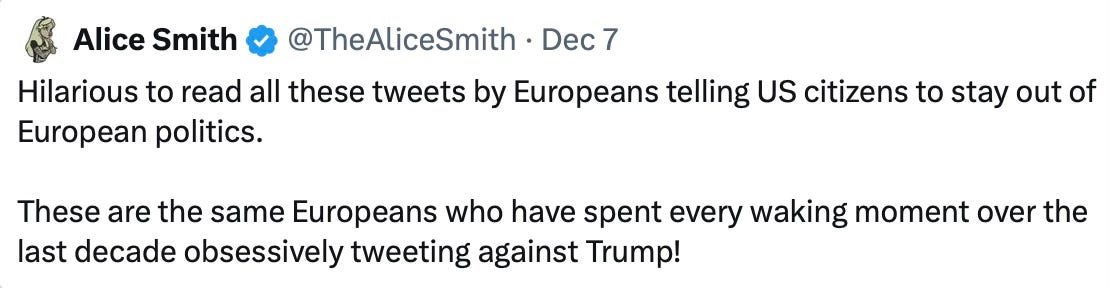
I like this one, too:

Trump’s deputy secretary of state Christopher Landau had a useful X/tweet about the scene a couple days ago:
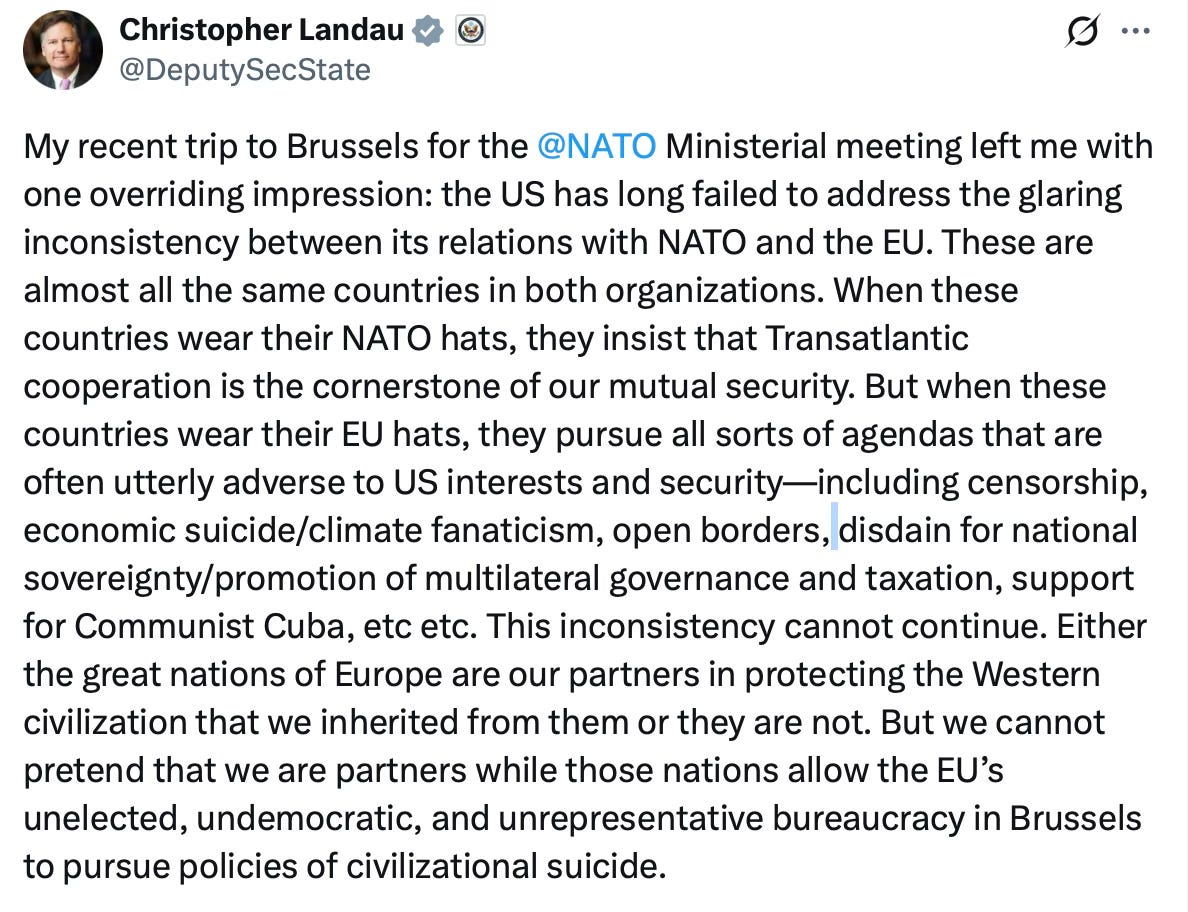
There’s an additional irony to the reaction to the NSS beyond the complaint that the U.S. is somehow giving up on “promoting democracy.” Back in the mid 1980s, when Irving Kristol and Owen Harries founded The National Interest, intended as a neocon partner to The Public Interest, one of they key arguments the journal sought to elevate was that America should stop cross-subsidizing Europe’s welfare states by assuming too much of the burden of NATO defense. Well, that is now explicit American policy as of last week, and neocons are said to be upset. (Actually I think this is an exaggeration or projection by Trump’s say-anything-at-hand enemies; I’ve noted some “neocons” who on the whole like the NSS.)
The undertone of contempt for Europe’s self-inflicted decline sent me back to Raymond Aron’s 1976 book, In Defense of Decadent Europe. You might guess from the title that Aron was defending Europe from Anglo-American chauvinism, but it’s quite the opposite. Keep in mind that Aron was one of the few prominent post-war French intellectuals who was not a lunatic. He went to some length to explain that the meaning of the book was the opposite of what might be mistaken from the title; in other words, he was making a case for how Europe could defend itself against decadence and decline, which he admitted was taking place at an alarming pace:
Let is consider some not so pleasant facts. In spite of its wealth, in spite (or because) of its culture and its freedoms, Western Europe as a whole does not think it is capable of defending itself without assistance. In the face of the Soviet divisions that have been stationed in the heart of Europe for more than 30 years, it entreats the United States to ensure the political balance and its security by the maintenance of an American army—the symbol of nuclear deterrence.
Thus, in one sense of the word, the decadence of Western Europe is beyond doubt. To dispose of any objections, it is enough to replace the word decadence by the word decline.
Aron, who died in 1983, didn’t foresee the rise of mass migration to Europe, but he was prescient about several other issues that are now front and center. Recall the passage in the NSS about “cratering birthrates” in Europe, and then behold this passage from Aron, which, among other things, anticipates not only the question of fertility rates, but my thoughts about why environmental apocalypticism appeals to leftists:
The enthusiastic reception given to the first ridiculous report of the Club of Rome hinted at a strange taste for apocalyptic visions, a kind of fear of the future. When I incline myself to a pessimistic diagnosis, I remind myself of what are, nowadays, the two most striking features of the attitude of individuals toward “society,” namely, expecting everything from it and giving nothing to it—at any rate, nothing which might deprive them of any pleasure and cost them any sacrifice. For some years now, this contradiction has become symbolized by the falling birthrate in France, Western Europe, and the United States. Nobody—or hardly anybody—has worried about the possible, if not probable, consequences of two of the ideas so warmly advocated by President Giscard d’Estaing: legalization of abortion and the move toward equal status and equal conditions for men and women. . .
It remains to be seen whether, when births have been reduced to the desired number, there will be enough of them to replace the previous generation. Biology does not forbid it, and justice demands that there be legal and professional equality between the sexes, but how is equality to be prevented from bringing with it a gradual identity of roles? For the career woman, children are becoming a nuisance and a contretemps.

Meanwhile, as if offering a coda to the NSS, J.P.Morgan’s highly respected CEO Jamie Dimon (who I believe is still a registered Democrat) offered this thought about Europe a few days ago at the Reagan Library’s annual National Defense Forum:
It takes 27 nations to make a decision. They let their military drop dramatically. It’s very bureaucratic. It’s part of the reason that they lost Britain... We allowed Europe to fall apart... They’ve gone from 90% of the GDP of America to 65%. That’s not because America did anything bad to them. It’s their own bureaucracy, their own cost... They do some wonderful things on their safety nets, but they’ve driven business out, they’ve driven investment out, they’ve driven innovation out.
Europeans may wish to ignore Trump, but one thing about European elites you can usually count on is that they pay attention to bankers.
I've read the referenced National Security Strategy paper, and I second Prof Hayward - it's worth the read.
But to Steven's question: Yes, Europe can be saved but only by Football Hooligans, not by Brussels' Bureaucrats.
I've thought for the last ten years that Europe seems to be dying of the wounds sustained in the two world wars. So a better question is "does Europe want to save itself?"